
Water-Fed Pole vs. Traditional Squeegee: Which Is Better?
Each method wins on different glass. A water-fed pole with purified water is best for exterior and upper-story windows and frames. A squeegee is best for interior glass, detail work and anything that needs treatment. Here’s how they compare, side by side.
Call or text a few photos. Flat quote, usually the same day.
- Short answer
- Comparison table
- Pure water
- Which to choose
Pole Outside, Squeegee Inside
Water-fed poles scrub glass and frames with purified water and leave them to dry spot-free, from the ground. Squeegees give a crisp, dry finish on interior glass and are the tool for detail work. Most professional visits use both.
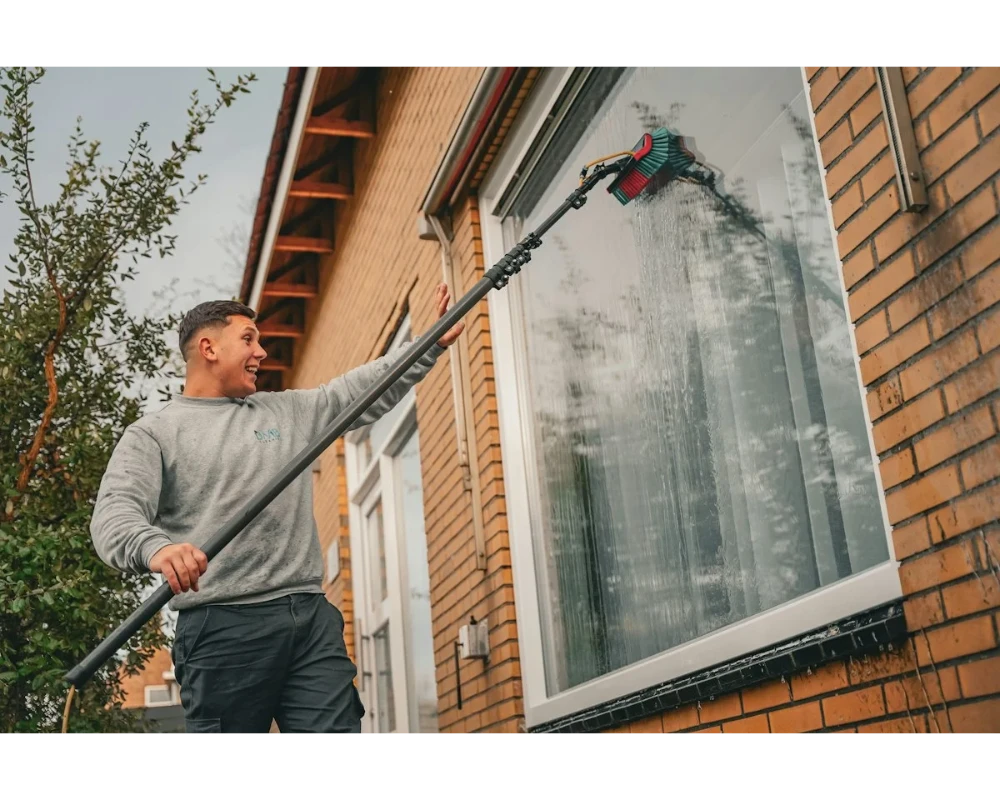 Water-fed pole window cleaning in Santa Cruz
| Water-fed pole | Squeegee | |
|---|---|---|
| Best for | Exterior and upper-story glass | Interior glass and detail work |
| Water | Purified (very low TDS) | Soapy tap water |
| Drying | Air dries spot-free | Squeegeed dry |
| Frames and sills | Scrubbed and rinsed | Wiped separately |
| Upper floors from the ground | Yes, within reach | Needs a ladder |
| Indoors | No | Yes |
| Hard water spot removal | No | With separate treatment |
| Salt film | Removes well | Removes well |
The Water-Fed Pole Method
Scrub, rinse, leave it.
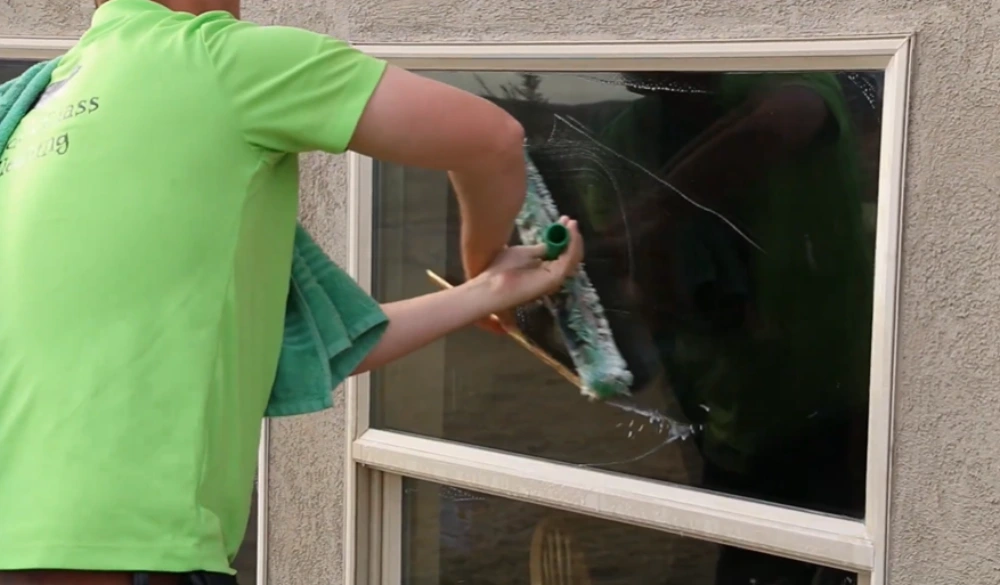 Squeegee and strip washer window technique
A water-fed pole is a long, lightweight pole, often carbon fiber or fiberglass, with a soft brush at the end and small jets that spray water onto the glass. The water is tap water run through filters, usually reverse osmosis and deionization, that remove nearly all dissolved minerals. The cleaner scrubs the glass and frame with the brush, rinses everything down with the pure water, and walks away. With no minerals in the water, it dries without spots.
| Step | What happens |
|---|---|
| Filter | Tap water is purified through reverse osmosis and deionization |
| Measure | A TDS meter checks the water is pure enough |
| Scrub | The brush loosens dirt, salt and pollen on glass and frames |
| Rinse | Pure water carries the dirt off the glass |
| Dry | The glass air dries with nothing left behind |
See what water window cleaners use for more on purification and TDS.
Sources: Pure Water Power, RO/DI cart operations manual; Wikipedia, Window cleaner.
The Squeegee Method
Wash, pull, detail.
The traditional method uses a strip washer or sponge to wet the glass with a little mild soap in water, then a squeegee with a sharp rubber blade to pull the water off in clean strokes, and a dry cloth to detail the edges. It leaves the glass dry immediately, which is why it’s the standard for interior glass, and it lets the cleaner feel the surface and spot problems up close.
| Step | What happens |
|---|---|
| Wet | Strip washer applies soapy water and loosens dirt |
| Pull | The squeegee removes the water in overlapping strokes |
| Detail | A lint-free cloth dries the edges and corners |
| Check | The glass is checked at an angle in the light |
See how professionals get streak-free results.
Sources: Wikipedia, Squeegee.
Where the Two Methods Come From
Both are standard tools of the trade.
The squeegee has been the window cleaner’s core tool for generations: a rubber blade on a handle that pulls water off glass in a single stroke. Water-fed poles came later, as filtration made it practical to carry purified water to the job and rinse glass clean without drying it by hand. Today most professional window cleaners carry both and choose by the glass in front of them.
Sources: Wikipedia, Squeegee; Wikipedia, Window cleaner.
Cleaning More Than the Glass
Frames hold the dirt that runs back onto glass.
 Washing patio door glass exterior
A squeegee clean focuses on the glass; frames and sills get a separate wipe. A water-fed pole brush scrubs the frame along with the glass, and the rinse carries the dirt down and away. On coastal homes, where salt builds up on aluminum frames, that matters: the aluminum industry’s cleaning guide notes that foggy coastal areas can build up heavy layers of atmospheric salts on finishes. Screens are cleaned separately with either method.
| Part | Water-fed pole | Squeegee |
|---|---|---|
| Glass | Scrubbed and rinsed | Washed and squeegeed |
| Frames | Scrubbed and rinsed with the glass | Wiped separately |
| Sills | Rinsed | Wiped |
| Screens | Removed and rinsed separately | Removed and rinsed separately |
| Tracks | Vacuumed and wiped separately | Vacuumed and wiped separately |
Sources: AAMA 609 and 610-09 Cleaning and Maintenance Guide for Architecturally Finished Aluminum.
Wind, Sun and Rain
Conditions affect each method differently.
| Condition | Water-fed pole | Squeegee |
|---|---|---|
| Direct sun | Pure water still dries clear | Glass can dry before squeegeeing; work in shade |
| Wind | Long poles are harder to control | Less affected |
| Light fog | Works; glass dries slower | Works |
| Rain | Exterior work rescheduled | Interior work continues |
See cleaning windows in direct sunlight and the best time of year for window cleaning.
Why the Water Matters
Water-fed pole cleaning only works with very pure water.
TDS stands for total dissolved solids: the minerals and salts dissolved in water that stay behind when it evaporates. Tap water across much of Santa Cruz County is hard, which is why hoses and sprinklers leave white spots. Purified water for window cleaning is filtered until TDS reads close to zero. One pure water equipment maker’s manual says spotting can occur once readings rise above 10 ppm.
| Water | Typical result if left to dry on glass |
|---|---|
| Hard tap water | White mineral spots |
| Softer tap water | Fainter spots |
| Purified water near 0 ppm TDS | Dries clear |
The EPA’s secondary drinking water standards list a guideline of 500 mg/L for total dissolved solids, a nuisance standard for taste and appearance rather than health. Window cleaning water needs to be far purer than that.
Sources: Pure Water Power, RO/DI cart operations manual; US EPA, Secondary Drinking Water Standards.
Ground Work vs. Ladder Work
Fewer ladders means fewer chances to fall.
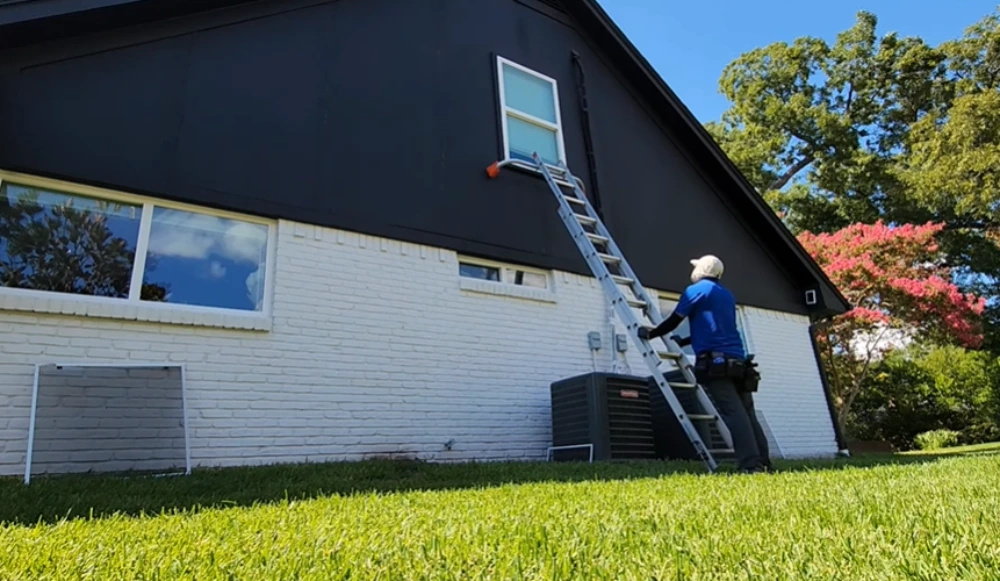 Ladder setup second-story window cleaning
The biggest practical difference on two-story homes is where the cleaner stands. With a water-fed pole, most upper glass is cleaned from the ground. With a squeegee, upper exterior glass needs a ladder. NIOSH reports that more than 500,000 people in the US are treated for ladder-related injuries each year and about 300 die. Keeping work on the ground also avoids setting ladders on garden beds, decks and slopes.
Sources: CDC NIOSH Science Blog, It’s National Ladder Safety Month (2017).
Choosing the Method for Each Window
Most homes need both.
| Glass | Best method | Why |
|---|---|---|
| Second-story exterior windows | Water-fed pole | Reach from the ground |
| Ground-floor exterior windows | Either | Pole cleans frames; squeegee gives instant dry finish |
| Interior glass | Squeegee | No rinsing water indoors |
| Ocean-facing view glass with salt film | Water-fed pole | Scrub and pure water rinse lifts salt |
| Glass with hard water spots | Squeegee plus treatment | Spots need hands-on removal |
| Skylights | Either, from the roof | Depends on access |
| Solar panels | Soft brush and pure water | Within the panel maker’s instructions |
What Each Method Can’t Do
Knowing the limits avoids disappointment.
| Method | Limitation |
|---|---|
| Water-fed pole | Won’t remove bonded hard water spots or etching |
| Water-fed pole | Not for interior glass |
| Water-fed pole | Needs a pure water supply and enough rinse to avoid drips |
| Squeegee | Upper exterior glass needs ladders |
| Squeegee | Frames and sills need separate wiping |
| Both | Can’t fix failed seals or etched glass |
See what causes white film on coastal windows and can hard water stains be removed.
Why Water-Fed Poles Suit Coastal Homes
Salt film and hard tap water both favor pure water.
Salt dissolves in water, so a scrub and pure water rinse lifts the film that fog leaves on ocean-facing glass and frames. And because so much local tap water is hard, rinsing with a hose leaves spots, while purified water doesn’t. Inside the house, and for spot treatment, the squeegee is still the right tool. See protecting windows from salt air and why Santa Cruz windows get dirty so fast.
Water-Fed Pole vs. Squeegee: FAQ
What is a water-fed pole?
A long, lightweight pole with a brush at the end that sprays purified water. The brush scrubs the glass and frame, and the purified water rinses it and dries without spots, with no squeegee needed.
Is a water-fed pole better than a squeegee?
Neither is better everywhere. Water-fed poles are best for exterior glass, upper floors and frames. Squeegees are best for interior glass, detail work and glass that needs extra scrubbing or treatment.
Why does water-fed pole cleaning need pure water?
Because the glass is left wet to air dry. Tap water would leave mineral spots. Purified water has had nearly all dissolved minerals removed, so there’s nothing left behind when it dries.
Will a water-fed pole leave spots?
Not if the water is pure enough and the glass is rinsed properly. One pure water equipment maker’s manual says spotting can occur once readings rise above 10 ppm of total dissolved solids.
Can water-fed poles be used inside?
No. They rely on rinsing water down the glass, which isn’t practical indoors. Interior glass is cleaned with a squeegee and cloth.
Do water-fed poles clean window frames too?
Yes. The brush scrubs frames and sills as it goes, and the rinse carries the dirt away, which a squeegee clean usually doesn’t do as thoroughly.
Can a water-fed pole remove hard water spots?
No. Pure water won’t dissolve bonded mineral spots. Those need separate treatment by hand after a test area.
Is it safer than a ladder?
Generally, because the cleaner stays on the ground. NIOSH reports more than 500,000 ladder-related injuries treated each year in the US.
Does it work on salt film?
Yes. Salt dissolves in water, so scrubbing and rinsing with pure water removes the coastal salt film well.
Which method do you use?
Both. Water-fed pole for most exterior and upper glass, squeegee for interiors, detail work and anything that needs treatment.
How high can a water-fed pole reach?
It depends on the pole and the site. Many poles extend to cover second- and third-story glass on homes. We confirm reach for your building when we quote.
Will water-fed pole cleaning damage my plants?
No. It uses purified water with no soap, so the rinse running into garden beds is just water.
Is the glass dry when you leave?
With a water-fed pole the glass may still be wet and finishes drying on its own, without spots. With a squeegee it’s dry when we leave.
Do you need to come inside for water-fed pole cleaning?
No. Exterior water-fed pole work is done entirely outside, so you don’t need to be home as long as gates are open.
Are windows cleaned with a water-fed pole as clean as swab and squeegee?
On exterior glass, yes, and often more even, because the brush scrubs the frame too and pure water rinses the whole window. It won’t remove bonded hard water spots, and it isn’t for interior glass. For inside glass and detail work, a squeegee gives the best finish, which is why we use both.
Can I buy a water-fed pole for home use?
You can, but the pole alone isn’t enough. Without purified water the glass will spot as it dries, so you also need a filter system and a way to check the water’s TDS.
Why do some cleaners still use ladders?
For glass a pole can’t reach well, for detail work, for hard water treatment, and for interior high windows. A pole isn’t the right tool for every pane.
Does a water-fed pole work on tinted or coated glass?
Generally yes, since it uses only pure water and a soft brush. Check your glass or film maker’s instructions if you’re unsure.
Can a hose-style pole system really clean without scrubbing?
No, and it isn’t meant to. A water-fed pole has a soft brush that scrubs the glass and frame while it sprays. The scrub loosens dirt, salt and pollen, and the purified water carries it off and dries without spots. A rinse alone with no brush work, or a rinse with tap water, leaves dirt or spots behind.
Can a water-fed pole scratch the glass?
It’s gentle on glass. The pole uses a soft brush and purified water with no soap, so nothing hard touches the surface. The bigger scratch risk with any method is gritty dust wiped across dry glass, and a pole wets and rinses as it scrubs. For tinted or coated glass, check your glass or film maker’s instructions if you’re unsure.
Get a Free Window Cleaning Quote in Santa Cruz County
Send your address and a few photos. You’ll hear back the same business day with a flat number.
(831) 203-3111- Same-day response, Monday through Saturday
- Flat quote, good for 30 days
- Add gutters, solar or skylights to the same visit
Serving Santa Cruz, Capitola, Aptos, Soquel, Live Oak, Scotts Valley, Felton, Ben Lomond, Bonny Doon, Watsonville and everywhere in between.