
How Do Professional Window Cleaners Get Streak-Free Results?
Streak-free glass comes from technique more than products: a little soap, a sharp squeegee, keeping the glass wet until the blade removes everything, and dry edges. Here’s how professionals do it, why home cleaning usually streaks, and what you can copy.
Call or text a few photos. Flat quote, usually the same day.
- Short answer
- Why DIY streaks
- Squeegee technique
- Pure water
Remove All the Water Before It Dries
A streak is anything left on the glass when it dries: soap, dirt, oil or minerals. Professionals avoid streaks by loosening the dirt with a light solution, pulling all of it off with a sharp squeegee in one controlled pass, and wiping the edges dry. For high exterior glass, many use purified water that leaves nothing behind when it dries.
 Streak-free window glass after professional cleaning
| What causes streaks | What professionals do instead |
|---|---|
| Too much soap | A small amount of mild soap in a bucket of water |
| Spray and wipe with paper towels | Scrubber to wash, squeegee to remove |
| Solution drying in the sun | Work in shade or keep the glass wet until squeegeed |
| Worn or nicked blade | Sharp rubber, changed when it wears |
| Water left at the edges | Edges and corners detailed with a dry cloth |
| Tap water drying on high glass | Purified water through a water-fed pole |
Want it done for you? Every residential window cleaning we do includes glass inside and out, frames, sills, tracks and screens, with a flat quote before we start.
Why Home Window Cleaning Leaves Streaks
Almost every streak comes from one of these six things.
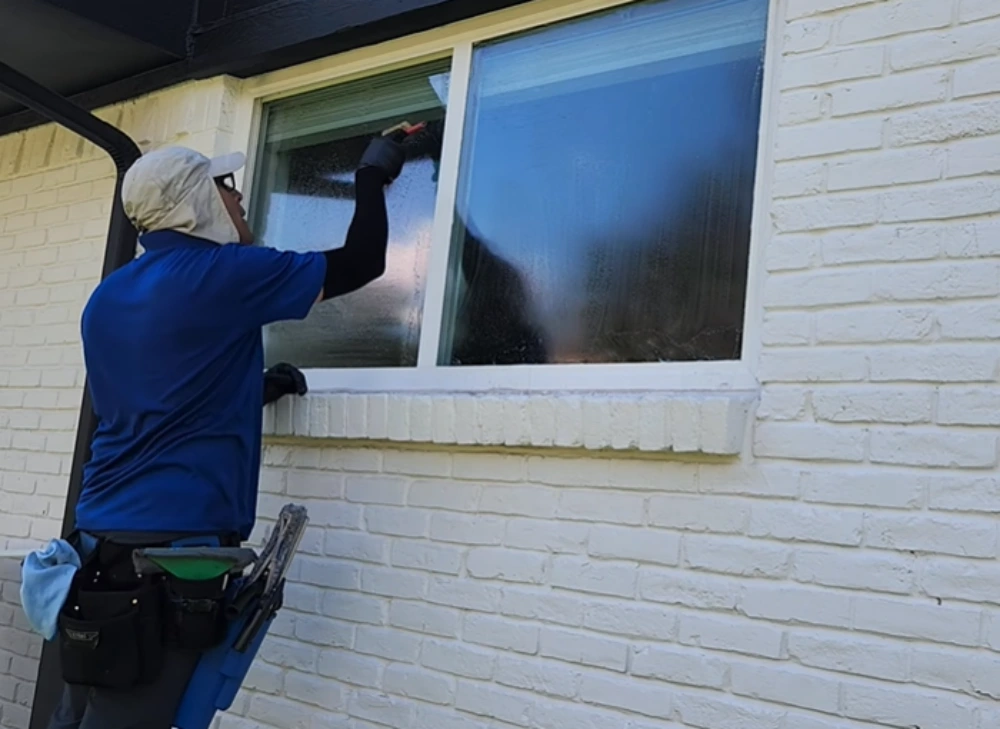 Washing exterior window brick house
Too much product
Extra soap or spray cleaner leaves a film. The more you use, the more there is to remove.
Direct sun
Heat dries the solution in seconds, before it can be wiped or squeegeed off.
Dirty water or cloths
Once the cloth or water is dirty, you’re spreading a thin layer of dirt evenly over the glass.
Paper towels
They shed lint and push the film around rather than lifting it off.
Missed edges
Water left along the frame runs back down the glass and dries as a line.
Hidden film
Salt from fog, cooking oil indoors or old residue that a quick wipe smears instead of removing.
This Old House notes the same point about timing: sun dries the cleaning solution before it can be squeegeed, which leaves streaks. Milgard’s care guide recommends mild dish soap and water for cleaning glass, rather than stronger products. See how to clean windows in direct sunlight.
Sources: This Old House, How Often Should Windows Be Cleaned?; Milgard, Window and Door Care Tips.
How Professionals Clean a Window Without Streaks
The same order every time, on every pane.
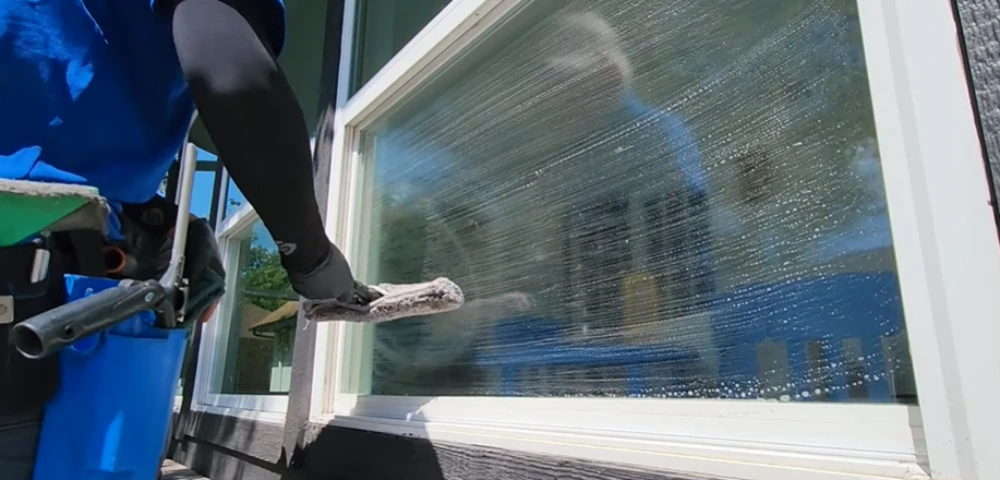 Strip washer soaping window glass close-up
Dust and dry-clean the frame
Loose dirt, webs and sand come off the frame and sill first, so they don’t wash into the solution.
Wash with a scrubber
A strip washer (scrubber) applies a light soap solution and loosens dirt, salt film and fingerprints across the whole pane.
Cut a dry edge
The squeegee starts along one side or the top, leaving a dry strip to work from.
Squeegee in one controlled pass
Using the fanning method or straight strokes, the blade pulls water and dirt off in one movement, always pushing water ahead of it.
Wipe the blade
The rubber is wiped after each stroke so dirt doesn’t get dragged back across clean glass.
Detail the edges
A dry, lint-free cloth takes off the thin line of water along the frame and in the corners.
Check from an angle
The glass is checked at a low angle, ideally in the light, where film and lines show up.
Wikipedia’s article on squeegees describes the same basics: the fan or swivel method keeps water away from the leading edge of the blade, holding the squeegee at a slight angle helps reduce lines, and worn blades hurt results.
Sources: Wikipedia, Squeegee.
The Tools Behind Streak-Free Glass
Each one does one job.
| Tool | What it does | Why it matters for streaks |
|---|---|---|
| Strip washer (scrubber) | Holds and applies the cleaning solution | Loosens dirt evenly so nothing is left stuck on |
| Squeegee with sharp rubber | Removes water and dirt in one pass | A clean, straight edge leaves no lines |
| Lint-free or microfiber cloth | Dries edges and corners | Stops edge water running back down |
| Bucket of fresh solution | Keeps the wash water clean | Dirty water leaves dirty film |
| Scraper (when the glass allows) | Removes stuck debris and paint specks | Debris can drag lines through the squeegee |
| Water-fed pole with purified water | Washes and rinses high exterior glass | Pure water dries without spots |
Scrapers need care. The IWCA notes that some tempered glass scratches easily, and glass makers such as Cardinal publish strict rules for cleaning their coated glass, including not using metal blades on certain coatings. We check the glass before any blade touches it.
Sources: IWCA, Glass Surface Information; Cardinal Glass, IG12 glass cleaning bulletin.
Fanning vs Straight Strokes
Two ways to move a squeegee. Both work when done right.
| Fanning (swivel) method | Straight strokes | |
|---|---|---|
| How it moves | Curved strokes that turn at the edges | Top to bottom, overlapping each stroke |
| Water control | Keeps water ahead of the blade the whole time | Leaves a line where strokes overlap |
| Speed | Takes practice | Easy to learn |
| Best for | Larger panes and experienced hands | Small panes and beginners |
| Streak risk | Lower | Higher at the overlaps |
Either way, the rule is the same: overlap slightly, keep the blade at a shallow angle, and wipe the blade between strokes. On divided-light windows and small panes, a smaller squeegee or a cloth is often quicker and cleaner.
Why Pure Water Dries Without Spots
On upper exterior windows, many professionals skip the squeegee and use purified water.
 Strip washer exterior window brick home
Tap water carries dissolved minerals. When it dries, the water leaves and the minerals stay, which is what water spots are. Purified water from a deionization or reverse osmosis system has almost nothing dissolved in it, so it dries clear. That’s why it can be used on a water-fed pole: the brush scrubs the glass, the pure water rinses it, and it’s left to dry without wiping.
Read more in our guide to what water professional window cleaners use, including how TDS meters check the water.
Sources: Wikipedia, Window cleaner.
Streak-Free Inside Glass
Inside glass is a different problem: oil, not salt.
| Inside film | Where it comes from | How it’s removed |
|---|---|---|
| Cooking grease | Kitchens and nearby rooms | A proper soap wash, then squeegee |
| Fingerprints and nose prints | Kids, pets, sliding doors | Soap wash; spray alone smears it |
| Smoke and candle residue | Fireplaces, candles | Soap wash, sometimes twice |
| Old cleaner residue | Repeated spray cleaning | Wash with plain mild soap to remove it |
Inside glass is done with floors and furniture protected and with the same squeegee method. Water-fed poles aren’t used indoors.
When Cleaning Won’t Fix It
Some marks look like streaks but aren’t on the surface you’re cleaning.
| What you see | Likely cause | Will better cleaning fix it? |
|---|---|---|
| White spots that don’t wipe off | Hard water minerals bonded to the glass | Needs mineral treatment |
| Haze that never clears | Etched glass | No |
| Fog or droplets between the panes | Failed seal in a double-pane unit | No; the unit needs repair |
| Fine scratches visible in sunlight | Scratched glass | No |
| Rainbow sheen on some glass | Coatings or surface film | Sometimes |
If you’re unsure, our guide to white film on coastal windows explains how to tell these apart, and hard water stain removal covers mineral spots.
How to Get Streak-Free Windows Yourself
You can get close to professional results on ground-floor glass.
- Pick a cloudy day, early morning or the shady side of the house
- Use a few drops of mild dish soap in a bucket of water, not a strong cleaner
- Wash with a sponge or scrubber, not paper towels
- Buy a decent squeegee and replace the rubber when it nicks
- Wipe the blade after every stroke
- Dry the edges with a clean microfiber cloth
- Change the water when it looks dirty
- Check the glass from an angle before moving on
Upper floors, skylights and anything that needs a ladder are where hiring a professional pays off most. See what professional window cleaning includes.
Streak-Free Window Myths
Some popular tips make streaks worse.
| Myth | Reality |
|---|---|
| More cleaner gets glass cleaner | Extra product leaves extra film to remove |
| Clean in full sun so it dries fast | Fast drying is what causes streaks |
| Rain rinses windows clean | Rain spreads dirt and salt and leaves its own spots |
| Vinegar stops all streaks | It can help light mineral spots; technique matters more |
| Newspaper is the best cloth | A clean microfiber cloth and a squeegee do the job without ink or lint |
| A squeegee lasts forever | The rubber wears, nicks and hardens and needs replacing |
The common thread: streaks come from what’s left on the glass when it dries. Use less, remove all of it, and dry the edges.
Why Local Glass Is Harder to Get Streak-Free
Salt and hard water make streak-free glass harder here than in many places.
| Local factor | Effect on glass | What helps |
|---|---|---|
| Fog and salt near the coast | A film that smears if it’s only wiped | Wash properly, then squeegee |
| Hard water in Soquel Creek Water District areas | Tap water leaves spots as it dries | Squeegee dry, or rinse with pure water |
| Sprinklers hitting glass | Mineral spots on lower windows | Adjust sprinklers; mineral treatment |
| Redwood sap and pollen | Sticky film on glass under trees | Soap wash, sometimes twice |
Soquel Creek Water District lists hardness of 100 to 370 ppm across its service area, which runs from moderately hard to very hard. See the marine layer guide for why coastal glass gets dirty so fast.
Streak-Free Windows: FAQ
How do you clean windows without leaving streaks?
Use very little soap, a sharp squeegee blade and clean water, and work in the shade so nothing dries before you pull the squeegee. Wipe the blade between strokes, detail the edges with a dry lint-free cloth, then check the glass at an angle in good light.
Why does Windex leave streaks?
Spray cleaners often dry before they’re wiped off, especially in direct sun, and wiping spreads the dirty film around instead of lifting it. Paper towels add lint. Washing with a little mild soap and water and pulling it off with a squeegee leaves less behind.
Is it bad to clean windows in the sun?
It makes streaks more likely. Sun dries the cleaning solution before it can be squeegeed off. Shade or early morning is better.
How can a professional get glass so clean and fast when I struggle with Windex and newspaper?
Mostly tools and technique. A squeegee pulls all the water and dirt off the glass in clean strokes instead of smearing it around, and a dry lint-free cloth details the edges. Newspaper and paper towels leave ink or lint. High exterior glass is often rinsed with purified water that dries without spots.
Why do I see streaks only when the sun hits the window?
Low-angle sun shows thin films of soap, oil or minerals that are invisible in shade. The glass may look clean until the light changes.
Does vinegar stop streaks?
Vinegar can help cut light mineral spots, but streaks usually come from technique, residue or drying. Keep acidic cleaners off frames and coated glass and check your window maker’s guidance.
How often should a squeegee blade be replaced?
When it is nicked, rounded or hardened. A damaged blade leaves a line of water every pass, and no technique fixes that.
What is the fanning method?
A squeegee technique where the blade turns in curves across the glass so the water is always pushed ahead of it. It leaves fewer lines than straight strokes.
Do professionals use soap on windows?
Usually a small amount of mild soap in water, applied with a scrubber. Window makers such as Milgard recommend mild dish soap and water for glass.
Why are the inside of my windows streaky but not the outside?
Inside glass often has an oily film from cooking, hands and pets. It takes a proper wash with soap and a squeegee, not just a spray and wipe.
Why does my glass look clean in the shade but streaky in the sun?
Low, bright light shows thin films that you can’t see in shade. Check glass from an angle in good light before calling it done.
Get a Free Window Cleaning Quote in Santa Cruz County
Send your address and a few photos. You’ll hear back the same business day with a flat number.
(831) 203-3111- Same-day response, Monday through Saturday
- Flat quote, good for 30 days
- Add gutters, solar or skylights to the same visit
Serving Santa Cruz, Capitola, Aptos, Soquel, Live Oak, Scotts Valley, Felton, Ben Lomond, Bonny Doon, Watsonville and everywhere in between.