
Window Cleaning vs. Glass Restoration: How to Know Which You Need
Cleaning removes what’s sitting on the glass. Restoration works on the glass surface itself. If your windows still look cloudy or spotted after a proper cleaning, the problem is bonded minerals or etching, and that’s where restoration, or sometimes replacement, comes in.
Call or text a few photos. Flat quote, usually the same day.
- Short answer
- The test
- What each fixes
- Prevention
Clean First, Then Judge the Glass
Most cloudy windows only need cleaning. If the haze or spots survive a proper wash and pure water rinse, the minerals have bonded to the glass or etched it. Bonded spots can often be treated. Etching and scratches can sometimes be polished, but not always.
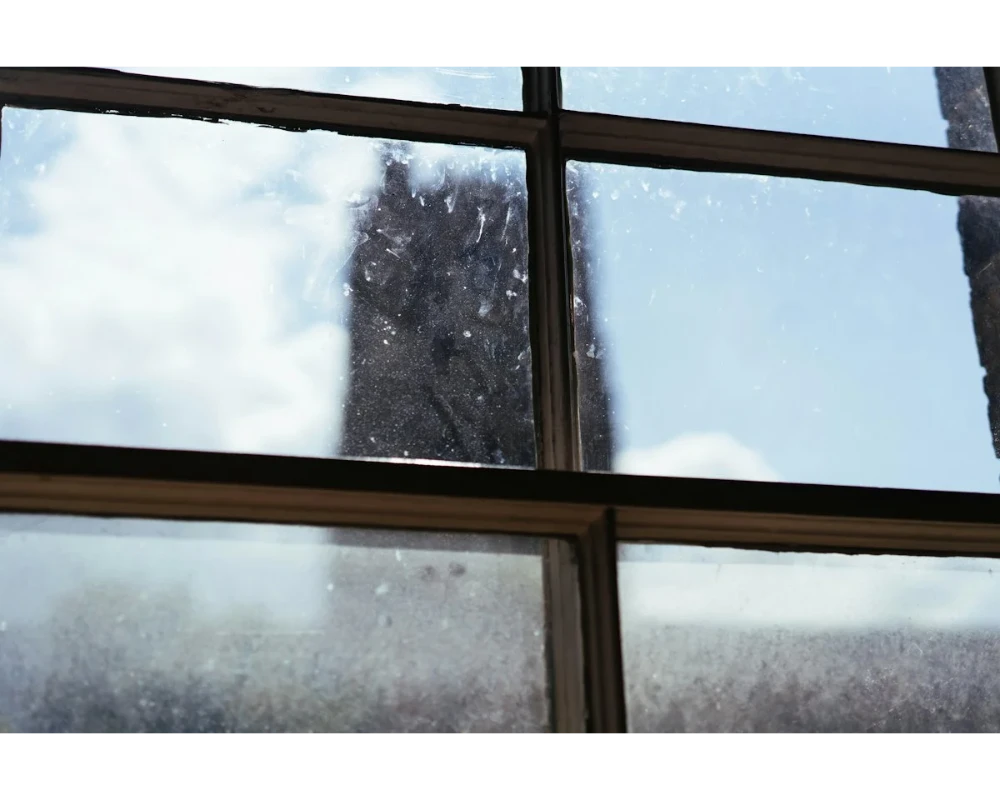 Hard water spots on window glass
| What you see | Cleaning | Restoration | Replacement |
|---|---|---|---|
| Dust, pollen, salt film | Yes | Not needed | No |
| Fresh sprinkler spots | Usually | Not needed | No |
| Bonded mineral spots | Partly | Treatment usually helps | Rarely |
| Light etching | No | Can improve | If results aren’t acceptable |
| Deep etching or scratches | No | Limited | Often the answer |
| Fog between panes | No | No | Seal or unit repair |
How to Tell What You’re Dealing With
Three quick checks before you call anyone.
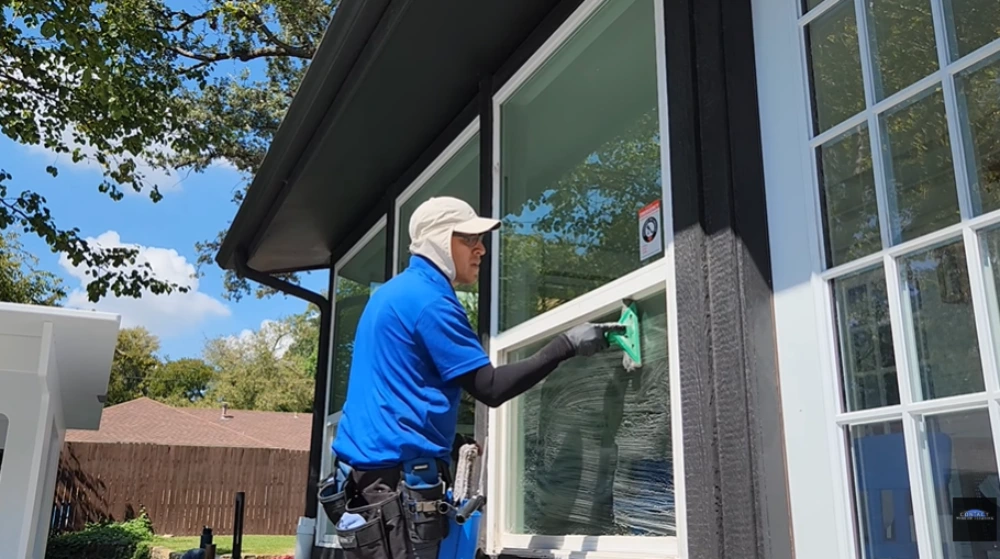 Window cleaner strip washer exterior window
Clean a test pane properly
Wash with mild soap and water, squeegee dry, and look at it at an angle in the light.
Wet it and compare
Mist the glass. If the spots disappear when wet and reappear when dry, they’re mineral deposits on the surface or shallow etching.
Run a fingernail over it
Spots you can feel are deposits sitting on the glass. A scratch that catches your nail is deep.
Check between the panes
If the haze is inside a dual-pane window, it’s a failed seal, not dirt or etching.
If you’d rather not test it yourself, text us a close-up photo in daylight and we’ll tell you what it looks like before quoting.
What Cleaning Removes
Most of what makes glass look dirty.
A professional cleaning removes everything sitting loosely on the surface: dust, pollen, salt film from fog, cobwebs, fingerprints and fresh mineral spots that haven’t bonded yet. Salt dissolves in water, so coastal haze comes off with a wash and rinse. A pure water rinse leaves no new spots behind. Frames, sills, tracks and screens are cleaned as part of the visit.
| Removed by cleaning | Not removed by cleaning |
|---|---|
| Dust, pollen and sap film | Minerals bonded for months or years |
| Salt film from fog and spray | Etching in the glass surface |
| Fresh sprinkler spots | Scratches |
| Soap and cleaner residue | Fog between dual panes |
| Ash, rinsed off first | Oxidized frame finishes |
See what causes white film on coastal windows and what water window cleaners use.
What Restoration Can Do
Working on the glass itself, carefully.
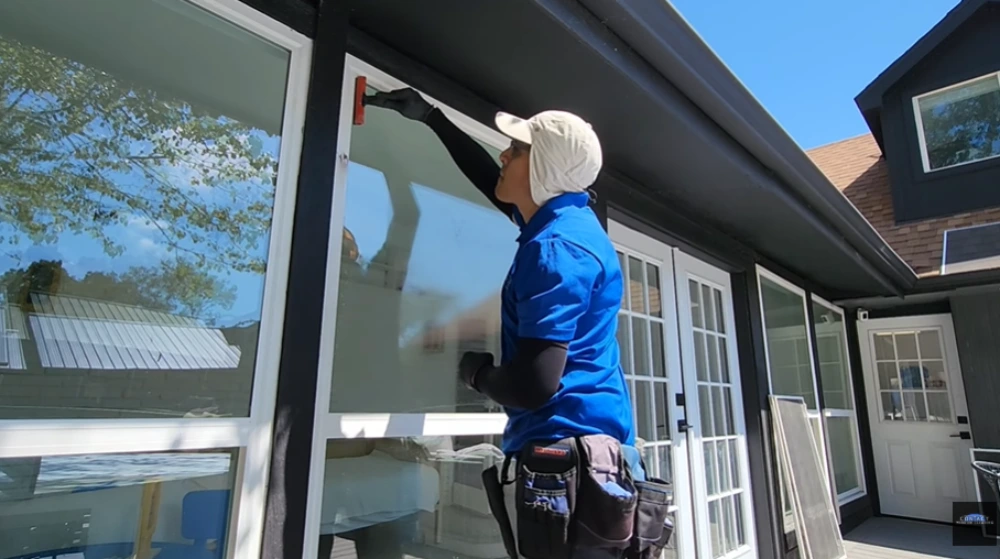 Window cleaner squeegee top of picture window
Restoration means treating or polishing the glass surface. For bonded hard water deposits, that usually means a mineral treatment worked into the glass after a test area. For light etching and light scratches, it can mean polishing with a fine compound such as cerium oxide. Polishing has limits: a scratch that catches a fingernail may not polish out without distorting or cracking the glass, and polishing must be kept wet so the glass doesn’t overheat.
| Problem | Typical approach | Realistic outcome |
|---|---|---|
| Bonded hard water spots | Mineral treatment after a test area | Often much improved or cleared |
| Light etching | Careful polishing | Improved; may not be perfect |
| Light scratches | Polishing | Often reduced |
| Deep scratches | Polishing is risky | Replacement often better |
Coated glass needs extra care. Glass makers such as Cardinal publish strict cleaning rules for coated products, and the IWCA notes that some tempered glass scratches easily. Check your glass maker’s guidance before anything abrasive touches the glass.
Sources: Natural Handyman, How to Remove Light Scratches and Stubborn Stains from Glass; Cardinal Glass, IG12 glass cleaning bulletin; IWCA, Glass Surface Information.
How Glass Gets Etched
It happens slowly, then it’s permanent.
Etching usually starts with water left to dry on the same glass again and again. Sprinklers are the classic cause: they hit the same lower windows every morning, the water dries, and minerals build up in layers. Over time, alkaline residue left on glass can attack the surface itself. Vitro, a glass maker, publishes guidance on preventing glass corrosion that stresses keeping water and residue from standing on glass. Once the surface is etched, cleaning can’t undo it.
| Stage | What it looks like | What fixes it |
|---|---|---|
| Fresh spots | White dots that wipe off with effort | Cleaning |
| Bonded deposits | White rings that survive cleaning | Treatment |
| Early etching | Hazy patches visible when dry | Polishing may improve |
| Advanced etching | Permanent cloudiness | Replacement |
Sources: Vitro Architectural Glass, TD-105 How to Prevent Glass Corrosion.
Why This Comes Up So Often Here
Hard groundwater and sprinklers.
Much of mid-county runs on hard groundwater. Soquel Creek Water District’s hardness data lists ranges from 100 to 370 ppm across its service area, and San Lorenzo Valley Water District reported a 2022 average of 218 ppm for its Felton system. At those levels, every sprinkler cycle that reaches the glass leaves minerals behind. Homes in Aptos, Soquel, La Selva Beach and Felton see the most restoration-level spotting on lower windows.
See can hard water stains be removed and hard water stain removal.
Sources: Soquel Creek Water District, Water Hardness; San Lorenzo Valley Water District 2022 water quality report.
When the Haze Isn’t on the Glass at All
Some cloudiness comes from somewhere else.
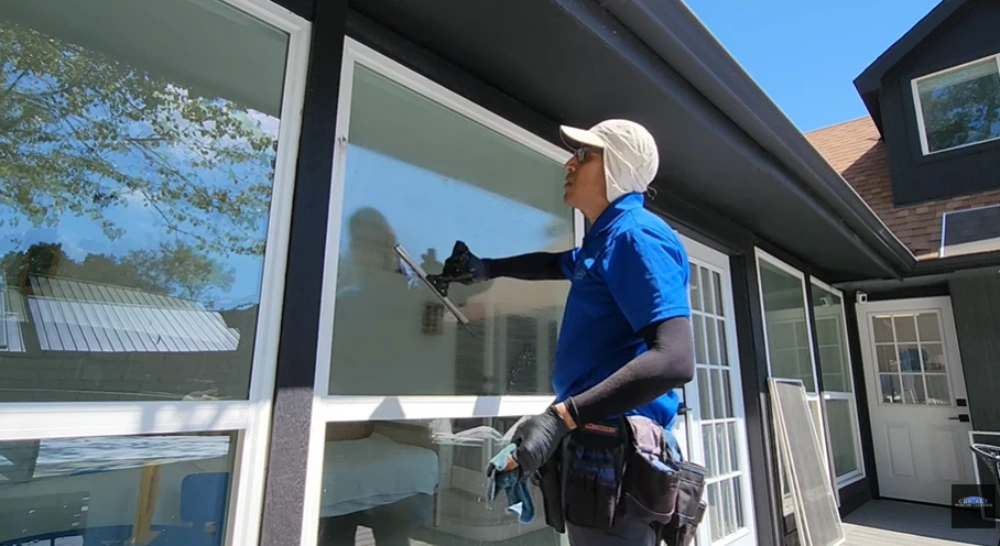 Window cleaner squeegee large window glass
Before deciding on restoration, rule out the things that look like glass damage but aren’t. Chalky runoff from oxidized painted or aluminum frames can streak down the glass every time it rains. Window film or tint applied to the inside can bubble or cloud with age. A failed seal on a dual-pane unit fogs the space between the panes. None of these is fixed by treating the glass surface.
| Looks like | Actually is | Fix |
|---|---|---|
| White streaks below the frame | Chalky runoff from an oxidized frame | Clean the frame; refinish if needed |
| Cloudy patches inside | Aging window film | Film removal or replacement |
| Haze you can’t reach | Failed dual-pane seal | Glass unit repair or replacement |
| Rainbow sheen | Residue or coating | Proper cleaning; check coatings |
The aluminum industry’s cleaning guide covers how frame finishes should be cleaned so they don’t chalk onto glass. See what causes white film on coastal windows.
Sources: AAMA 609 and 610-09 Cleaning and Maintenance Guide for Architecturally Finished Aluminum.
How We Handle Problem Glass
Test first, promise only what the glass allows.
Look and photograph
We check the glass in daylight and photograph the problem areas.
Clean normally
A full wash and pure water rinse shows what’s left.
Test a corner
Spot treatment is tried on a small area first.
Tell you the result
If it clears, we quote the rest. If it doesn’t, we tell you it’s likely etched.
Leave the decision to you
Treat what can be improved, or plan replacement for what can’t.
Restore or Replace?
A few questions decide it.
| Question | Leans restore | Leans replace |
|---|---|---|
| How many panes are affected? | A few | Many, or whole elevations |
| How deep is the damage? | Spots, light etching | Deep etching, deep scratches |
| Is the glass coated or specialty? | Maker allows treatment | Maker forbids abrasives |
| Is the seal failing too? | No | Yes, fog between panes |
| Is the window otherwise sound? | Yes | Frame or hardware failing |
For replacement, talk to a glass or window contractor. For cleaning and spot treatment, see residential window cleaning.
How to Avoid Needing Restoration
Cheaper than any fix.
- Turn sprinkler heads away from the glass
- Don’t hose windows off and let them air dry
- Clean on a schedule before minerals bond
- Rinse salt film off before it builds up
- Use only cleaning methods your glass maker allows
See how often to clean windows and protecting windows from salt air.
Window Cleaning vs. Glass Restoration: FAQ
What is the difference between window cleaning and glass restoration?
Window cleaning removes what sits on the glass: dirt, salt, pollen and fresh mineral spots. Glass restoration works on the glass surface itself, polishing out bonded mineral deposits or light damage that cleaning can’t lift.
Are these glass panels permanently etched?
Test it first. If the glass still looks cloudy or spotted after a proper cleaning, and the haze doesn’t change when the glass is wet, the surface may be etched. We test a corner before treating the rest and tell you honestly whether the spots will come off.
My picture window has water marks after a pressure wash and seems etched. Can it be cleaned?
Often, at least partly. Many water marks are mineral deposits that can be treated off. If the glass is truly etched, it can usually be improved but often not fully restored. We test a corner first and tell you what to expect before doing the whole window.
Is there a way to polish scratches out of window glass?
Light scratches you can’t feel with a fingernail can often be polished. If a scratch catches your fingernail, polishing may not remove it without distorting or cracking the glass. For deep or widespread scratches, replacing the glass may be the better choice.
What causes etching on windows?
Usually years of hard water drying on the same glass, often from sprinklers. Alkaline water and residue left on glass can attack the surface over time, which is why glass makers warn against letting it sit.
Is glass restoration worth it?
It depends on the window. For a few panes with moderate spotting, restoration is usually far less disruptive than replacement. For badly etched or scratched glass, replacement may be the better use of money.
Can coated or tempered glass be restored?
With care, and only within the glass maker’s rules. Coated glass has strict cleaning limits, and the IWCA notes some tempered glass scratches easily. Test areas and maker guidance come first.
Will regular cleaning prevent the need for restoration?
Mostly, yes. Cleaning before minerals bond and keeping sprinklers off the glass prevents most of the damage that leads to restoration.
Can fogged double-pane windows be repaired, or do they need replacing?
Cleaning can’t fix them. Fog between the panes of a double-pane window means the seal has failed, and neither cleaning nor restoration reaches inside the unit. The glass unit needs repair or replacement, so talk to a glass or window company about which option suits your window.
Do you do glass restoration?
We treat bonded hard water spots after a test area and tell you honestly if the glass is etched beyond what treatment can fix, so you can decide on replacement.
How long does hard water spot treatment take?
It depends on how many panes and how bonded the spots are. A test corner shows how stubborn they are, and the quote is based on that.
Can I use vinegar on hard water spots?
It can loosen light, fresh spots. Keep it off frames, seals and coated glass, and test a small area first. It won’t fix etching.
Does restoration make glass look new?
Treated spots can often clear completely. Etched glass may improve but not always to like-new. We’ll tell you after the test area.
Does hard water spot removal damage glass?
Done properly and within the glass maker’s rules, treatment removes deposits without harming sound glass. That’s why we test a corner first and avoid abrasives on coated or unknown glass.
Should I fix sprinklers before treating spots?
Yes. Treating spots while sprinklers still hit the glass means they come back. Adjust the heads first, then treat.
Can I prevent etching on new windows?
Yes. Keep sprinklers off the glass from day one, avoid letting hose water air dry on the windows, and have the glass cleaned before minerals have time to bond.
Get a Free Window Cleaning Quote in Santa Cruz County
Send your address and a few photos. You’ll hear back the same business day with a flat number.
(831) 203-3111- Same-day response, Monday through Saturday
- Flat quote, good for 30 days
- Add gutters, solar or skylights to the same visit
Serving Santa Cruz, Capitola, Aptos, Soquel, Live Oak, Scotts Valley, Felton, Ben Lomond, Bonny Doon, Watsonville and everywhere in between.