
Can Hard Water Stains Be Removed From Windows?
Usually, yes. Fresh spots come off with a mild treatment, bonded stains need a dedicated mineral remover, and stains left for years may have etched the glass, which can only be improved. Here’s how to tell which you have and what works on each.
Call or text a few photos. Flat quote, usually the same day.
- Short answer
- Severity scale
- What works
- What to avoid
Yes, If They Haven’t Etched the Glass
Hard water stains are minerals left behind when water dries on glass. While they sit on top of the surface, they can be dissolved and removed. The longer they stay, the harder they bond, and water that sits on glass for long enough can attack the glass itself. That’s the line between a stain and permanent damage.
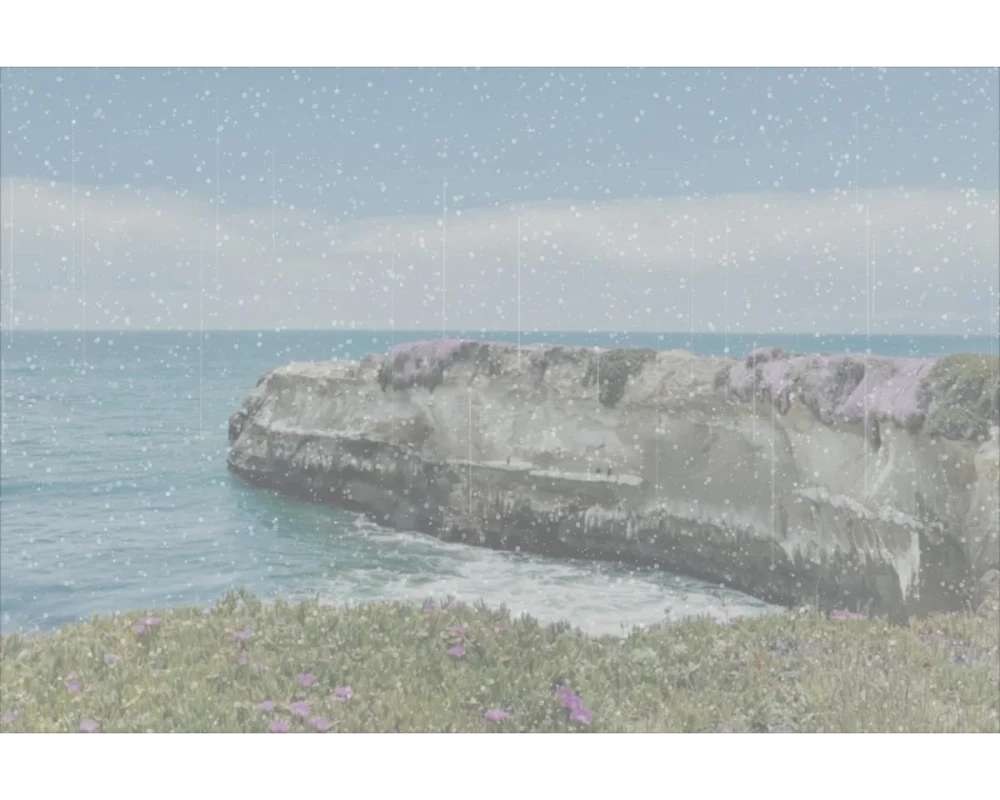 Hazy window glass before cleaning
| Severity | What it looks like | Can it be removed? |
|---|---|---|
| Light | Fresh white spots that change when you wipe them | Yes, usually DIY |
| Moderate | Spots and rings that don’t wipe off, rough to the touch | Yes, with mineral treatment |
| Heavy | Thick white crust along the bottom of the pane | Usually, with time and care |
| Etched | Haze that stays even when the glass is wet | Improved at best; sometimes replacement |
Want it done for you? Our hard water stain removal starts with a test corner, so you know what will come off before you pay for it.
What Hard Water Stains Actually Are
Not dirt. Minerals.
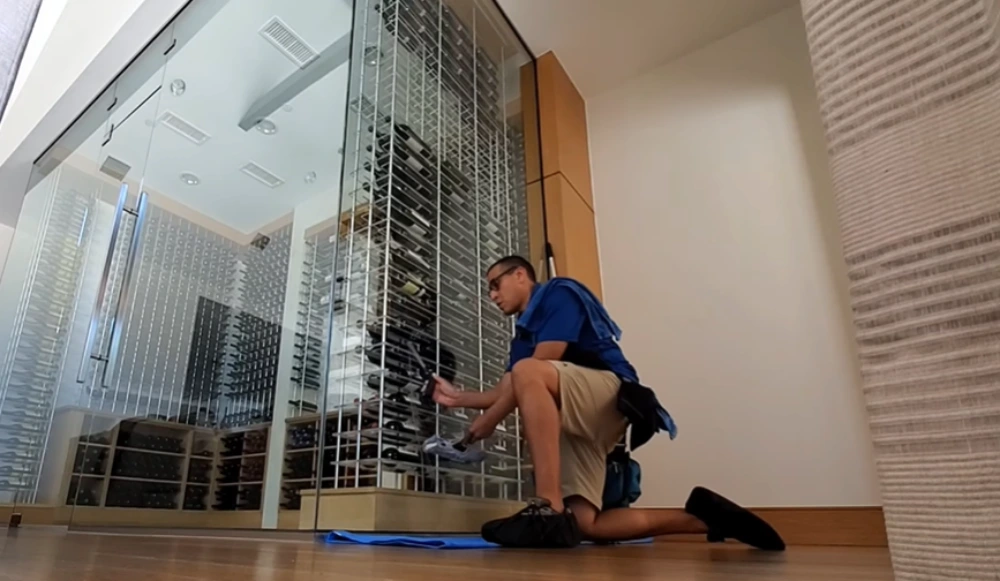 Wiping glass panel edge kneeling
Tap water carries dissolved calcium and magnesium. When a drop dries on glass, the water evaporates and the minerals stay behind as a white spot. One drop is easy to wipe off. The same sprinkler hitting the same pane every morning lays down layer after layer until the deposit bonds to the surface.
Vitro Architectural Glass’s technical document on glass corrosion explains the next stage. Water pulls sodium out of ordinary soda-lime glass and becomes more alkaline. Once it reaches a pH of about 9 or higher, it starts attacking the glass itself, which can leave pitting, a rainbow sheen or a translucent haze. At that point the glass is still strong, but it no longer looks clear.
| Stage | Where the problem is | What fixes it |
|---|---|---|
| Mineral spots | On top of the glass | Dissolving the minerals |
| Bonded deposits | Stuck firmly to the surface | Mineral remover, careful work |
| Corrosion (etching) | In the glass surface itself | Polishing, if anything; otherwise replacement |
Sources: Vitro Architectural Glass, TD-105 How to Prevent Glass Corrosion.
How to Tell a Stain From Etching
Three quick checks before you buy anything.
Wet the glass
Spray it with water. If the cloudy area disappears while wet and comes back as it dries, it’s usually a surface film or deposit. If it stays cloudy while wet, it may be etched.
Feel it when dry
Run a fingertip over it. A gritty, raised feel means deposits on top. Smooth glass that still looks hazy points to etching.
Try a small test area
On a corner, gently try a mild acidic cleaner, then rinse. If it changes, it’s a deposit. If nothing changes after a careful try, stop.
If you’re not sure, our guide to white film on coastal windows covers salt film, soap residue and frame runoff too, which can all look like hard water stains.
How Hard Water Stains Are Removed
Match the method to the severity.
 Window cleaning tool belt squeegee holster
| Severity | Method | Notes |
|---|---|---|
| Light spots | Mild acidic cleaner or diluted vinegar, then a proper wash and squeegee | Test a small area; keep it off frames and seals |
| Moderate deposits | Dedicated glass mineral remover, worked gently, then rinsed and cleaned | Follow the product and glass maker’s instructions |
| Heavy crust | Repeated mineral treatment, sometimes with a fine non-scratch pad approved for glass | Slow work; never dry |
| Light etching | Glass polishing compounds such as cerium oxide | Can improve clarity; not always fully |
| Heavy etching | Usually replacement | Polishing deep damage is rarely practical |
Vitro notes that lightly corroded glass can sometimes be restored with acidic detergents or polishing agents such as pumice or cerium oxide, but that heavily corroded glass is generally not worth restoring. Coated glass is a special case: many coatings can’t be polished or treated with abrasives at all.
Sources: Vitro Architectural Glass, TD-105 How to Prevent Glass Corrosion.
What Damages Glass When Removing Stains
Most damage comes from trying too hard with the wrong tool.
| Method | Risk | Safe? |
|---|---|---|
| Steel wool or scouring pads | Scratches glass and coatings | No |
| Razor blade on unknown glass | Some tempered glass scratches easily; some coatings forbid blades | Only on glass that allows it |
| Strong acids near frames | Can damage frame finishes, seals and hardware | No |
| Abrasive products on coated glass | Can strip or mark low-E and other coatings | No |
| Working in hot sun | Products dry on the glass and streak or spot | Work in shade |
| Mild acid, tested, rinsed | Low risk on uncoated glass | Yes |
The IWCA notes that some tempered glass is highly susceptible to scratching, and Cardinal publishes strict cleaning rules for its coated glass, including not using metal blades on certain coatings. Milgard’s care guide warns against abrasive or acidic cleaners on frame finishes.
Sources: IWCA, Glass Surface Information; Cardinal Glass, IG12 glass cleaning bulletin; Milgard, Window and Door Care Tips.
Removing Light Hard Water Spots Yourself
For fresh, light spots on ground-floor glass only.
Clean the glass first
Wash with mild soap and water and squeegee it off, so you can see what’s left.
Test a corner
Apply a mild acidic cleaner or diluted vinegar to a small area, following the product label.
Keep it off the frame
Protect frames, seals and sills, and wipe up drips right away.
Work it gently
Use a soft cloth or non-scratch pad approved for glass, and keep the glass wet.
Rinse and squeegee
Rinse thoroughly with clean water, then squeegee dry so you don’t add new spots.
Check it in the light
If the spots changed, repeat carefully. If nothing changed, stop; it may be bonded or etched.
When to Call a Professional
Some jobs are better left to someone who can test and treat glass safely.
| Situation | Why |
|---|---|
| Spots didn’t change after a careful test | They’re bonded or etched and need stronger, careful treatment |
| Coated, tinted or low-E glass | The wrong product can damage the coating |
| Upper-story glass | Ladder work plus chemicals is a bad mix |
| Large glass railings or walls of glass | Uneven results are easy to see |
| You’re about to sell or list the house | Results need to be right the first time |
Why Hard Water Stains Are So Common Here
Much of the county’s tap water is hard to very hard.
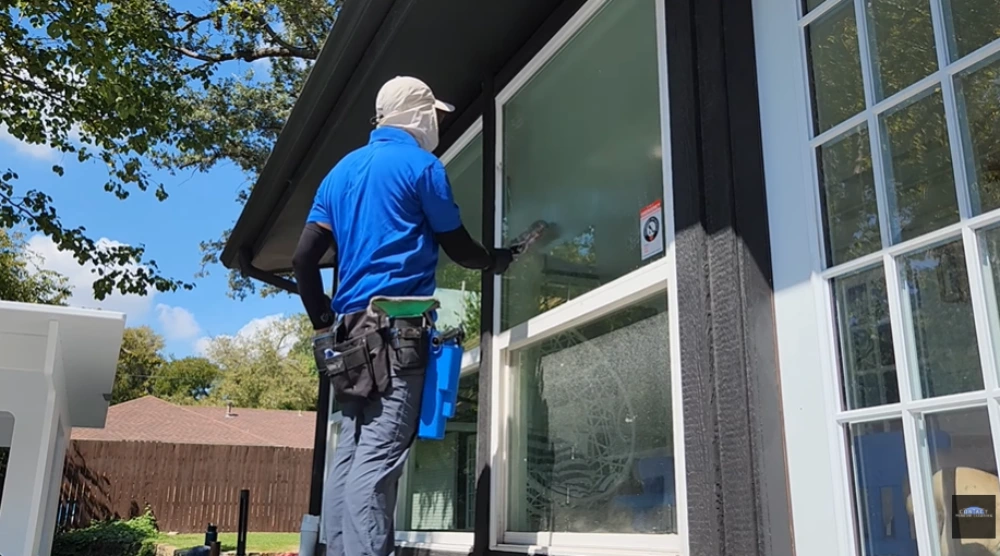 Window cleaner washing large home window
| Water system and area | Published hardness | Classification |
|---|---|---|
| City of Santa Cruz (city, most of Live Oak west of 41st Avenue) | Described as moderately hard | Moderately hard |
| Soquel Creek Water District: western Capitola and Soquel | 150 to 370 ppm | Hard to very hard |
| Soquel Creek Water District: Soquel and Aptos | 140 to 300 ppm | Hard to very hard |
| Soquel Creek Water District: Aptos and Rio del Mar | 150 to 200 ppm | Hard to very hard |
| San Lorenzo Valley Water District, main system (2022 average) | 108 ppm | Moderately hard |
| San Lorenzo Valley Water District, Felton system (2022 average) | 218 ppm | Very hard |
| Hardness (mg/L as calcium carbonate) | Classification |
|---|---|
| 0 to 60 | Soft |
| 61 to 120 | Moderately hard |
| 121 to 180 | Hard |
| Over 180 | Very hard |
Sprinklers that reach the windows are the most common cause we see. Capitola, Soquel and Aptos homes on Soquel Creek Water District water, and Felton homes on SLVWD’s Felton system, have the hardest water in the table above.
Sources: City of Santa Cruz Water Department, Water Quality FAQs; Soquel Creek Water District, Water Hardness; San Lorenzo Valley Water District 2022 water quality report; USGS, Water Hardness FAQ.
Glass Most Prone to Hard Water Stains
Anywhere water lands and dries.
| Glass | Common cause | Note |
|---|---|---|
| Lower windows | Sprinkler overspray | Usually the worst on the house |
| Sliding glass doors | Sprinklers, hoses, patio washing | Heavier near the bottom |
| Glass railings | Rain, sprinklers, hose rinsing | Both sides need treating |
| Shower doors | Daily shower water | Same minerals, same methods |
| Skylights | Water drying on a low-pitch surface | Acrylic domes need gentle methods |
| Solar panels | Hosing with tap water | Rinse with pure water instead |
How to Prevent Hard Water Stains
Stopping new spots is easier than removing old ones.
- Adjust sprinkler heads so they don’t reach the glass
- Water early so windows aren’t wet when the sun hits them
- Don’t rinse windows with a garden hose
- Squeegee shower glass after use
- Have exterior glass cleaned with deionized water, which dries without minerals
- Treat new spots early, before they bond
See what water professional window cleaners use for how pure water dries without spots, and how often to clean windows for a schedule.
Hard Water Stains on Windows: FAQ
Can old hard water stains come off glass?
Usually, yes. Fresh and moderate stains can be removed with the right treatment. Stains left for years may have etched the glass, and etching can only be improved, not always removed.
How do I remove hard water stains from glass?
Start with the mildest option and test a small area first. Mild acidic cleaners dissolve light, fresh spots. Bonded stains need a dedicated mineral remover and careful work, and etched glass needs polishing or replacement, not more cleaning. Keep products off frames and seals, and check your window maker’s rules for coated glass.
Is vinegar safe for hard water spots on windows?
It can loosen light, fresh spots. It won’t touch etching, and it should be kept off frames, seals and coated glass. Test a small area first.
Can hard water permanently damage glass?
Yes. Water that sits on glass can become alkaline and attack the surface. Vitro’s technical guidance describes this as glass corrosion, which can leave pitting or a permanent haze.
How do I know if my glass is etched?
If the cloudy area still looks cloudy when the glass is wet, or feels rough to a fingertip after cleaning, it’s likely etched rather than just stained.
Why are the stains only on my lower windows?
Lower windows catch sprinkler spray and hose splash. The water dries there day after day and leaves its minerals behind.
Would something abrasive help get hard water stains off glass?
Usually not. Steel wool and abrasive scouring pads can scratch glass, and we never use them. Some tempered glass scratches easily, and some coated glass makers say metal blades should never be used. Bonded stains need a mineral remover, and only etched glass gets a fine polishing pad, worked carefully after a test area.
How much hard water is too much for windows?
Any water left to dry on glass leaves something behind. On the USGS scale, water over 120 mg/L is hard and over 180 is very hard, and much of the Soquel Creek Water District falls in that range.
How do I stop hard water stains coming back?
Keep sprinklers off the glass, don’t rinse windows with a hose, and have the glass cleaned with pure water or squeegeed dry.
Do you remove hard water stains?
Yes. We test a small corner first to see whether the stain comes off or the glass is etched, then quote the treatment before we start.
Can I use CLR or lime remover on windows?
Only if the product says it’s safe for glass and your window maker allows it. Test a small area, keep it off frames and seals, and rinse well.
Will new windows get hard water stains?
Yes, if sprinklers or hoses keep hitting them. New glass isn’t immune; keep water off it and clean spots early.
How long does professional hard water stain removal take?
It depends on how many panes are affected and how bonded the stains are. After the test corner, you’ll get a time estimate and a flat quote.
How do I clean water spots off vinyl windows?
Treat the glass and the frame separately. On the glass, light spots usually come off with a mild acidic cleaner after a test patch. On vinyl frames, use mild soap and water, since Milgard warns that acidic or abrasive cleaners can permanently damage frame finishes. Rinse well and keep sprinklers off the windows so the spots don’t return.
Get a Free Window Cleaning Quote in Santa Cruz County
Send your address and a few photos. You’ll hear back the same business day with a flat number.
(831) 203-3111- Same-day response, Monday through Saturday
- Flat quote, good for 30 days
- Add gutters, solar or skylights to the same visit
Serving Santa Cruz, Capitola, Aptos, Soquel, Live Oak, Scotts Valley, Felton, Ben Lomond, Bonny Doon, Watsonville and everywhere in between.