
Roof Cleaning in Santa Cruz, CA
Black streaks, green algae and lichen removed with a low-pressure soft wash, not a pressure washer. We clean asphalt shingle, clay and concrete tile, and metal roofs from Davenport to Watsonville, and send dated before and after photos.
Call or text a few photos. Flat quote, usually the same day.
- Low-pressure soft wash
- No scrubbing shingles
- Plants protected
- Before and after photos
What the Black Streaks on Santa Cruz Roofs Are
Those dark streaks are usually algae, not dirt, soot or mold. The Asphalt Roofing Manufacturers Association identifies the main species as Gloeocapsa magma. It spreads by airborne spores, grows where a roof stays damp and shaded, and darkens over time. Fog, winter rain and tree cover make much of Santa Cruz County a good place for it.
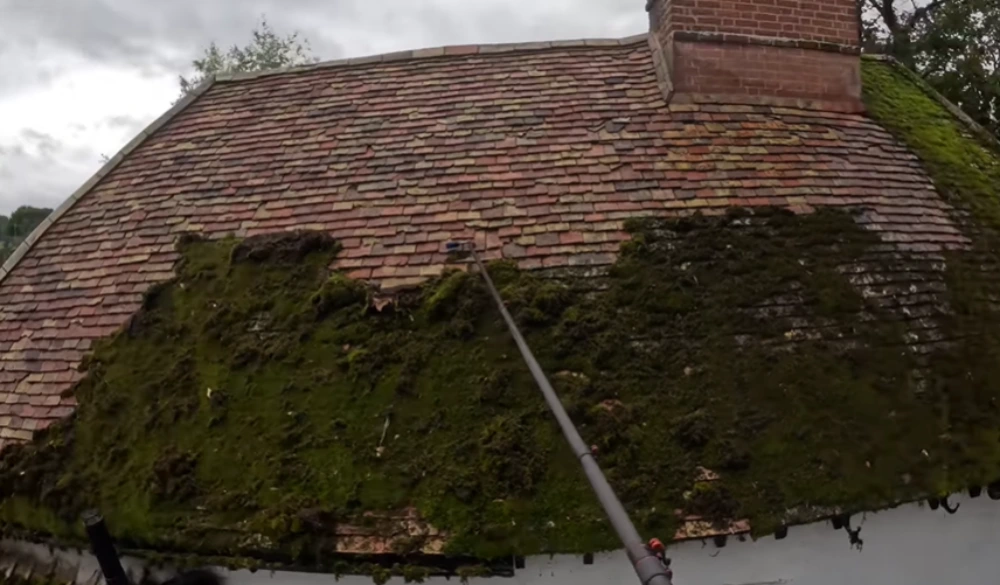 Half cleaned: the difference after a soft wash
Why are the streaks worse on the north side of my roof? North-facing slopes get less sun, stay cooler and hold moisture longer, so algae establishes there first. Shade from redwoods, oaks and neighboring houses has the same effect, which is why one side of a Santa Cruz roof can be dark while the other looks fine.
Sources: IIBEC / ARMA, Algae Discolorations of Roofs; Bob Vila, Black Roof Stains? Check for Algae.
Algae, Moss and Lichen on a Roof
Each one looks different and needs a slightly different approach. Most Santa Cruz roofs we see have more than one.
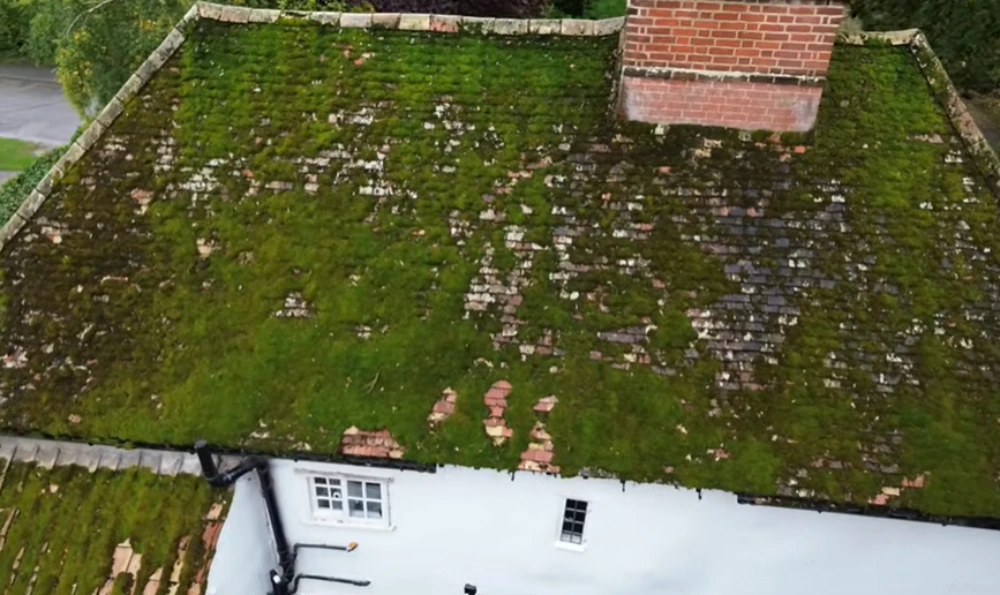 Moss and lichen on tile before cleaning
| Growth | What it looks like | Where it shows up | What we do |
|---|---|---|---|
| Algae (Gloeocapsa magma) | Black or dark gray streaks running down the slope | North faces, shaded slopes, below roof edges | Soft wash treatment, rinse at low pressure |
| Moss | Green, raised clumps that hold water | Shaded roofs under redwoods and oaks, tile joints | Remove by hand, then soft wash what is left |
| Lichen | Flat, crusty gray-green or yellow patches | Older roofs, dry and sunny spots as well as shade | Soft wash; patches fade over weeks |
| Dirt and pollen | Even, light film | Roofs near roads and pine or eucalyptus | Rinse during the soft wash |
Green clumps on a shady roof are moss, and moss is the one to deal with first because it holds water against the roof and washes into gutters. If moss is the main problem, see our moss removal service. If it is mostly dark streaking, a soft wash is the right tool.
Soft Washing vs Pressure Washing a Roof
ARMA advises that high-pressure washing should not be used to remove algae from asphalt shingles, and warns that scrubbing can loosen the granules that protect the shingle from sun. A soft wash relies on the cleaning solution to kill the growth and uses water pressure only to apply and rinse it.
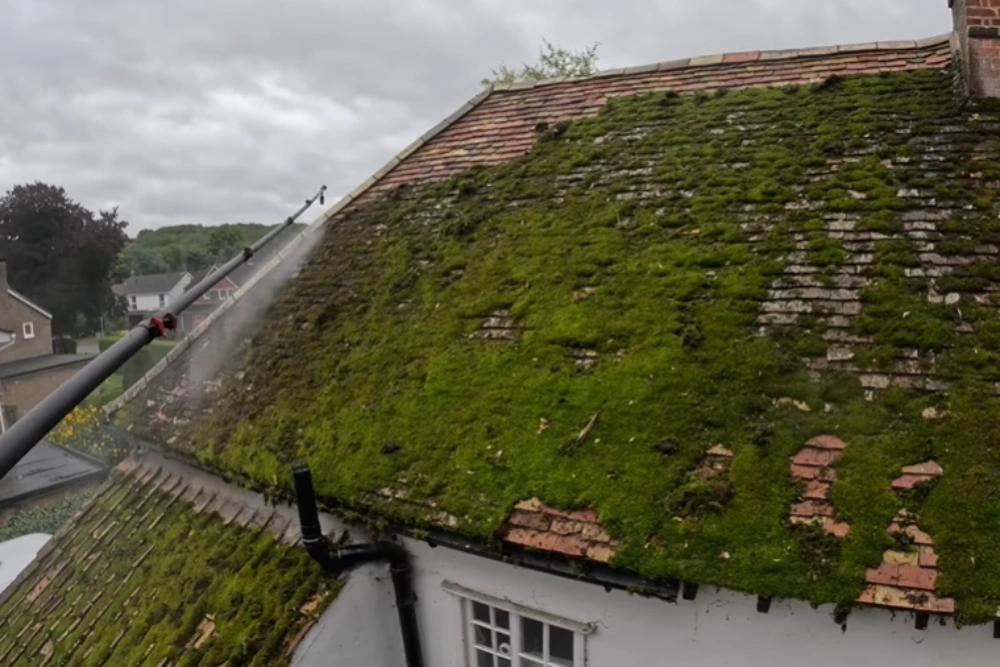 Low-pressure application with an extension lance
| Soft wash | Pressure washer | |
|---|---|---|
| How it cleans | Cleaning solution kills algae, moss and lichen | Force of the water blasts growth off |
| Effect on asphalt shingles | Granules stay in place when done correctly | Can strip granules and lift shingle edges |
| How long it lasts | Kills the growth, so it returns more slowly | Leaves roots and spores behind |
| Water forced under shingles or tiles | Low pressure, low risk | Higher risk around laps and flashing |
| What we use on roofs | Yes | No |
If you want the longer version of this, our guide on soft wash vs pressure wash covers every exterior surface, not just roofs.
How We Clean a Roof, Step by Step
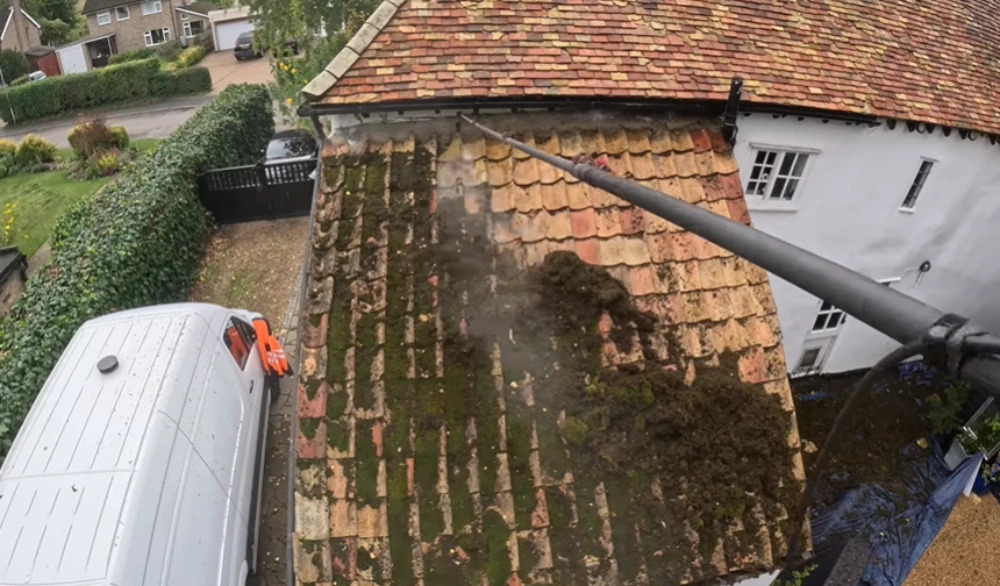 Working the lower roof first
Look first
We check the roof from the ground and the edge: material, pitch, how heavy the growth is, and any loose, cracked or missing shingles or tiles. We point out anything a roofer should see before we start.
Protect the yard
Plants, lawn and soft surfaces below the roofline are wetted down and covered where needed. Downspouts that run to the street or a storm drain are redirected so wash water stays on the property.
Remove loose moss by hand
Thick moss and debris come off by hand from the edges and tile joints, then get bagged. This keeps clumps out of the gutters.
Apply the soft wash
The cleaning solution goes on at low pressure, working from the bottom of each slope up, and is given time to work on the algae and lichen.
Rinse at low pressure
The roof is rinsed with low-pressure water. Nothing is scrubbed and no pressure washer touches asphalt shingles.
Clear gutters and send photos
We clear what washed into the gutters, rinse the plants again, and send dated before and after photos of each slope.
Roof Cleaning for Asphalt, Tile and Metal Roofs
Santa Cruz County has a real mix of roofs: asphalt shingle on most ranch and tract homes, clay and concrete tile on Spanish and Mediterranean styles, and standing-seam metal on some newer and rebuilt homes. Each one gets a different approach.
Asphalt shingle
The most common roof here and the one most prone to black streaks. Soft wash only, no scrubbing, no walking more than needed.
Clay and concrete tile
Moss settles in the joints and lichen on the face. We hand-clear joints, soft wash, and step only where the tile is supported.
Metal
Metal sheds water well but collects algae and dirt film near fasteners and on shaded panels. Low-pressure treatment and rinse.
Should I just leave the streaks alone? You can. The Asphalt Roofing Manufacturers Association describes the discoloration mainly as a cosmetic problem, and some owners live with it. The reasons people clean anyway are curb appeal before a sale, an insurer or HOA asking about the roof, or growth that has moved on to moss and lichen, which hold water against the shingles.
Why Santa Cruz County Roofs Grow Algae
Three local things keep roofs damp: morning fog and the marine layer through summer, a rainy season that runs roughly from late fall into spring, and tree cover. Roofs under redwoods in Felton, Ben Lomond and Boulder Creek may see little direct sun on one side all year.
 Debris bagged and hauled, not washed into gutters
| Where you live | What we usually find | How often roofs need attention |
|---|---|---|
| Coastal: West Cliff, Pleasure Point, Seacliff, Rio Del Mar | Algae streaks and salt film, lichen on older roofs | Every few years, sooner on shaded slopes |
| Mid-county: Live Oak, Soquel, Capitola, Aptos | Streaks on north faces, moss under oaks | Every few years, after heavy wet winters |
| San Lorenzo Valley and hills: Felton, Ben Lomond, Boulder Creek, Bonny Doon | Moss, needles and heavy algae under redwoods | More often; check every fall |
| Scotts Valley and Watsonville | Pollen, dust and lighter algae | Less often unless shaded |
These are patterns we see, not guarantees. A roof in full sun on the Westside can stay clean for years, while a shaded roof two streets over needs regular work.
What Happens to the Runoff
The City of Santa Cruz notes that storm drains flow to the nearest body of water without any treatment, so pollutants can reach local creeks, the San Lorenzo River and Monterey Bay. We keep cleaning solution out of gutters that drain to the street and out of storm drains.
- Downspouts that discharge to the street are redirected onto landscaping or capped during the job.
- Plants are wetted before, during and after treatment so they do not absorb concentrated solution.
- Rinse water is kept on the property, and gutters are flushed into a contained area.
Sources: City of Santa Cruz, Stormwater Residential Information.
Cleaning Your Own Roof vs Hiring Us
Plenty of homeowners clean a low, single-story roof themselves. Here is the honest comparison.
| Doing it yourself | Hiring us | |
|---|---|---|
| Safety | A treated roof is slippery; falls are the main risk | Ladders, stabilizers and roof safety gear |
| Equipment | Pump sprayer, protective gear, plant covers | Low-pressure soft wash rig and lances |
| Even coverage | Hard from a ladder or the ground | Applied slope by slope |
| Plants and runoff | Your responsibility | Protected and managed as part of the job |
| Photos for an insurer or buyer | Your own | Dated before and after photos sent to you |
If you do it yourself, follow the product label, never pressure wash asphalt shingles, cover or wet your plants, and stay off a wet roof. If any part of that sounds uncomfortable, call us.
Roof Cleaning FAQ
Is there a way I can clean the black streaks off my roof myself, or do I have to hire somebody?
You can do it yourself if you can work on the roof safely. The usual method is a bleach-based solution applied gently with a pump sprayer, left to work and then rinsed with low-pressure water, with plants covered or wetted first. A treated roof is slippery, so most homeowners hire it out for anything above a single story or on a steep pitch.
Can a roof cleaner be applied with a garden hose attachment, or do I need to get on the roof?
Some products are sold for hose-end sprayers, but even coverage on a whole roof is hard to get from the ground, and the label decides the method. We apply from ladders and roof edges with low-pressure equipment so the solution goes on evenly without anyone walking on wet shingles more than needed.
Will a soft wash damage my asphalt shingles?
Done correctly it should not. Soft washing uses low water pressure with a cleaning solution, rather than force, to kill the growth. What damages shingles is high pressure and scrubbing, both of which can loosen the protective granules. We do not scrub or pressure wash asphalt shingles.
Does roof cleaning void the shingle warranty?
Pressure washing is the method roofing groups warn against, and some warranties exclude damage from it. A low-pressure soft wash is a different process. Warranty terms vary by manufacturer, so check yours before any roof cleaning, and ask the cleaner which method they use.
Do I need a new roof, or will a cleaning do?
If the shingles are lying flat, holding their granules and not leaking, staining alone is not a reason to replace them. A cleaning removes the discoloration. If you see curling, cracked or missing shingles, or bare spots where granules are gone, have a roofer look at it. We clean roofs; we do not inspect or certify them.
Are algae-resistant shingles worth it when I replace my roof?
For shaded, damp roofs they are worth asking about. Several major manufacturers make shingles with copper in the granules to slow algae growth. They cost a little more than standard shingles, and a roofer can tell you which lines are available locally.
How soon will the streaks disappear after a soft wash?
Light algae staining usually lightens the same day. Heavier growth, lichen and moss can take days to weeks to fade as the dead material weathers off in rain. We tell you on site which areas will look clean right away and which will improve over time.
Do you clean tile and metal roofs too?
Yes. Clay and concrete tile get the same low-pressure soft wash, with extra care for footing because tiles can crack under weight. Metal roofs are rinsed and treated at low pressure, with attention to fasteners and seams.
Get a Free Window Cleaning Quote in Santa Cruz County
Send your address and a few photos. You’ll hear back the same business day with a flat number.
(831) 203-3111- Same-day response, Monday through Saturday
- Flat quote, good for 30 days
- Add gutters, solar or skylights to the same visit
Serving Santa Cruz, Capitola, Aptos, Soquel, Live Oak, Scotts Valley, Felton, Ben Lomond, Bonny Doon, Watsonville and everywhere in between.