
Deck & Patio Cleaning in Santa Cruz, CA
Redwood, cedar and pressure-treated decks cleaned gently, composite boards washed within the manufacturer’s limits, and patios of pavers, flagstone and concrete brought back. We protect your plants, keep wash water out of the storm drain, and can clean the glass railings too.
Call or text a few photos. Flat quote, usually the same day.
- Low pressure on redwood and cedar
- Composite to brand specs
- Pavers and flagstone
- Glass railings detailed
How a Deck Should Be Cleaned
Most deck damage comes from cleaning, not weather. Too much pressure raises the grain on softwoods like redwood and cedar, and chlorine bleach breaks down the wood fibers. We clean wood with a deck cleaner, a soft brush and a low-pressure or hose rinse along the grain, then brighten redwood and cedar. Composite boards are cleaned to the limits their manufacturer sets.
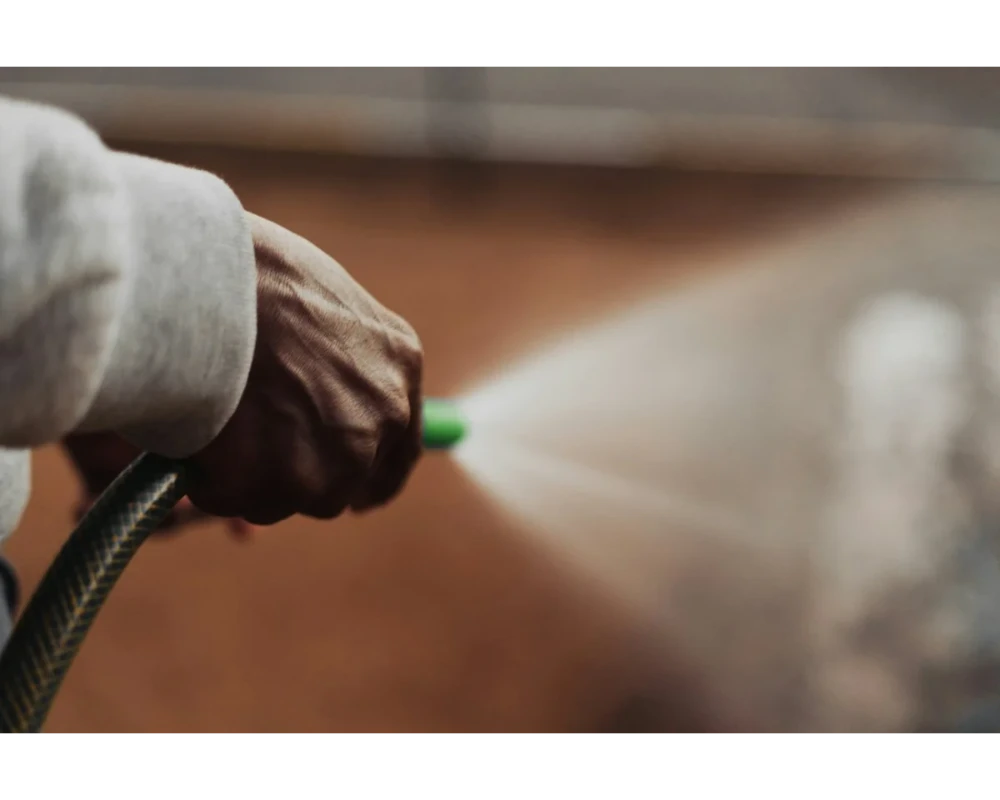 Gentle rinse for softwood decks
Can older Trex boards be pressure washed? Not according to Trex. For its early generation boards, including Accents, Origins, Contours, Profiles and Brasilia, Trex does not recommend a pressure washer at all. Its newer Transcend, Enhance and Select boards can take up to 3100 psi with a fan tip held at least 8 inches from the surface. Knowing which board you have matters before any machine comes out.
For the difference between soft washing and pressure washing across the whole house, see soft wash vs pressure wash. This page is about decks, patios and the railings around them.
What a Deck and Patio Cleaning Includes
The same list every time, adjusted to your boards and stone.
Deck boards
Surface boards cleaned of dirt, mildew, algae and leaf stains, rinsed along the grain.
Railings and stairs
Rails, balusters, posts and stair treads cleaned, including the tops where dirt collects.
Brightening
Oxalic acid brightener on redwood and cedar for tannin and iron stains, if your deck needs it.
Patio surfaces
Pavers, flagstone and concrete patios cleaned with the right pressure for each.
Glass railings
Glass panels washed and squeegeed, with no abrasive pads or scrapers.
Plants and runoff
Plants wetted and covered loosely, and wash water kept out of the street.
Redwood, Cedar and Pressure-Treated Decks
Redwood is a common decking wood in Santa Cruz County, and there is still a redwood sawmill on the North Coast, Big Creek Lumber in Davenport. Redwood and cedar are soft, rich in tannins and easy to damage with pressure. The Western Red Cedar Lumber Association says power washers are not recommended for cedar decks, and Olympic recommends a hose instead of a power washer for redwood and dark cedar.
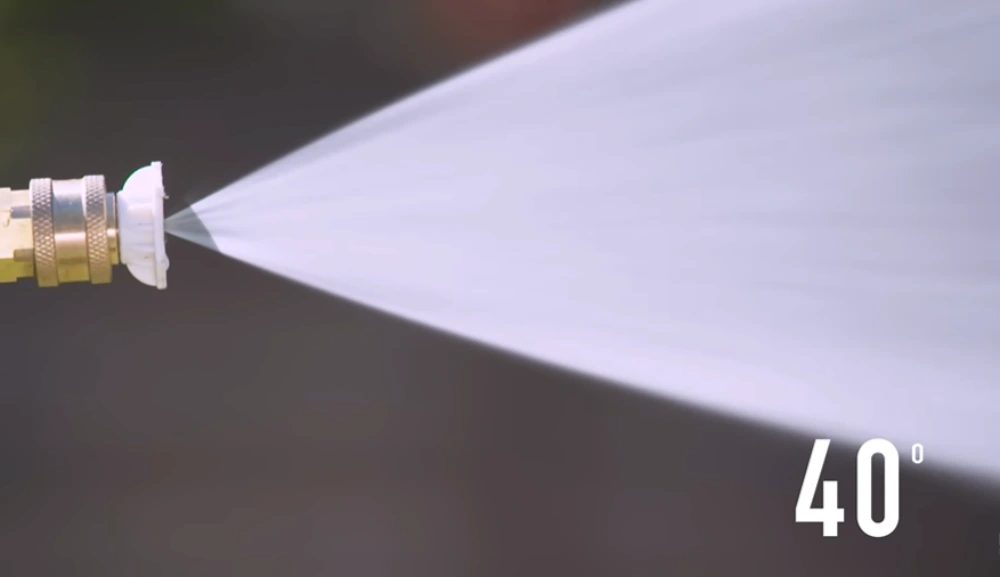 A wide fan tip at low pressure
| Problem | Usually caused by | What fixes it |
|---|---|---|
| Blue-black stains, often around nails | Tannins reacting with iron | Oxalic acid brightener; replace rusting fasteners |
| Gray, dull boards | Sun and weathering of the surface fibers | Deck cleaner, soft brush, gentle rinse, then brightener |
| Dark fan-shaped spots | Mildew | Oxygen bleach cleaner and a soft brush |
| Fuzzy, raised grain | Too much pressure or chlorine bleach | Light sanding once dry |
| Green film in the shade | Algae | Deck cleaner, more sun and air if possible |
- No chlorine bleach on wood. It breaks down lignin, leaves a whitewashed look and can corrode fasteners.
- No wire brushes or steel wool. Bits of metal left in the wood cause new black stains.
- Rinse along the grain, never across it.
Sources: Western Red Cedar Lumber Association, Deck Care and Maintenance; Olympic, Deck Cleaning; Treated Wood, Cleaning Wood Decks; California Redwood Association, Exterior Finishes.
Composite Decks Have Their Own Limits
Composite boards do not need brightening or staining, but they do get mold, pollen film and grease stains. The bigger issue is that each manufacturer sets its own pressure limit, and going over it can void the warranty. We check which boards you have before choosing how to clean them.
| Brand | What the manufacturer says about pressure washing |
|---|---|
| Trex Transcend, Enhance, Select | Up to 3100 psi with a fan tip, held at least 8 inches from the boards |
| Trex early generation (Accents, Origins, Contours, Profiles, Brasilia) | Pressure washer not recommended |
| TimberTech | Maximum 1500 psi with a fan tip, along the grain, for rinsing only |
| Fiberon | Use extreme caution, under 2500 psi, held 12 inches above the surface |
Across brands the advice is similar: warm soapy water and a soft brush for routine dirt and mold, a thorough rinse so dirty water does not dry into a film, and no cleaning in direct sun where cleaner can dry on the boards. TimberTech also warns against stiff natural-fiber brushes on its boards.
Sources: Trex, Care and Cleaning; TimberTech, Care and Cleaning Guide; Fiberon, Composite Decking Care.
How We Clean a Deck, Step by Step
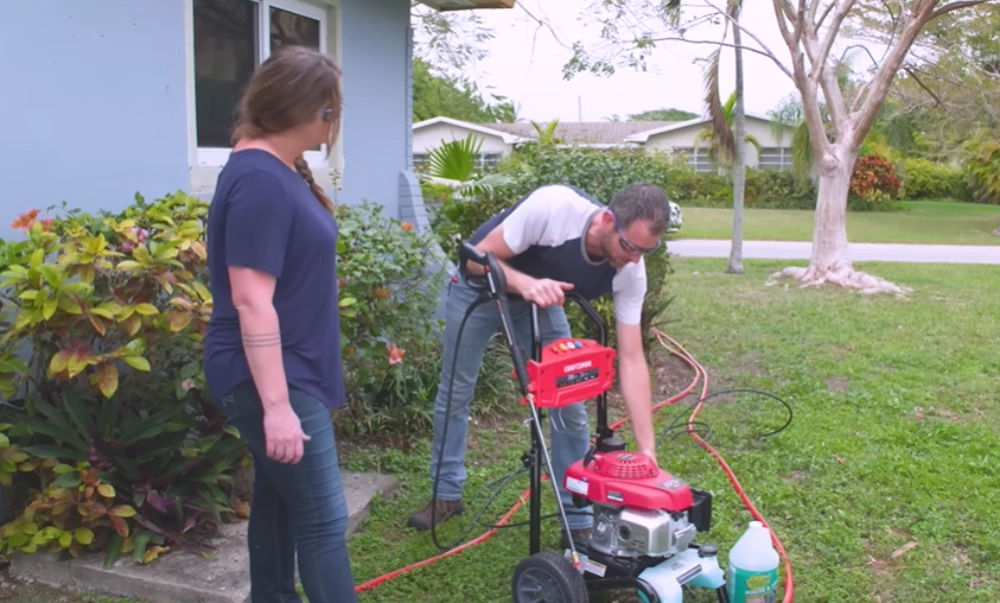 Setting the pressure before we start
Identify the boards
We check whether the deck is redwood, cedar, pressure-treated wood or composite, and for composite, which brand and line, because that decides the cleaner and the pressure.
Clear and protect
Furniture, planters and grills are moved, plants are wetted and loosely covered, and drain inlets nearby are blocked.
Apply the cleaner
Wood gets an oxygen bleach deck cleaner and composite gets a cleaner suited to the brand. It is worked in with a soft brush, out of direct sun, and not allowed to dry.
Rinse along the grain
Boards are rinsed with a hose or a low-pressure fan tip along the grain, within the manufacturer’s limit for composite.
Brighten wood if needed
Redwood and cedar get an oxalic acid brightener to clear tannin and iron stains and even out the color, then a final rinse.
Rinse plants and check
Plants get a final rinse, we check for raised grain or loose boards, and tell you when the wood should be dry enough to stain.
Getting a Deck Ready for Stain
If you are staining the deck yourself or have a painter lined up, the cleaning is the most important part of the job. Cabot estimates that 85 to 90 percent of the labor in a deck finish should go into surface preparation.
Wood fences need the same care before stain. See fence cleaning.
| Step | What to know |
|---|---|
| Drying time | Behr says to let the deck dry completely, which may take about 24 hours. It can take up to two days, and longer after rain or in the shade. |
| Water test | Sherwin-Williams says the deck is ready when water droplets soak in instead of beading. |
| New decks | New wood usually needs several weeks of weathering before it will take stain. |
| Raised grain | Sand any fuzzy fibers once the wood is dry, or the stain will look blotchy. |
| How often | The California Redwood Association says semi-transparent stains on redwood need redoing every three to five years. |
How do I know if my deck needs new stain? Sprinkle some water on the boards. If it beads up, the finish is still protecting the wood. If it soaks in, the wood is ready for cleaning and a new coat. A new deck usually needs to weather for several weeks before it will take stain.
Sources: Cabot, Technical Bulletin 12; Behr, How to Prep a Deck; Sherwin-Williams, How to Prep and Stain Your New Deck.
Patios: Pavers, Flagstone and Concrete
Patios get the same organic growth as decks plus spilled food, grease and rust from furniture. The cleaning depends on the surface.
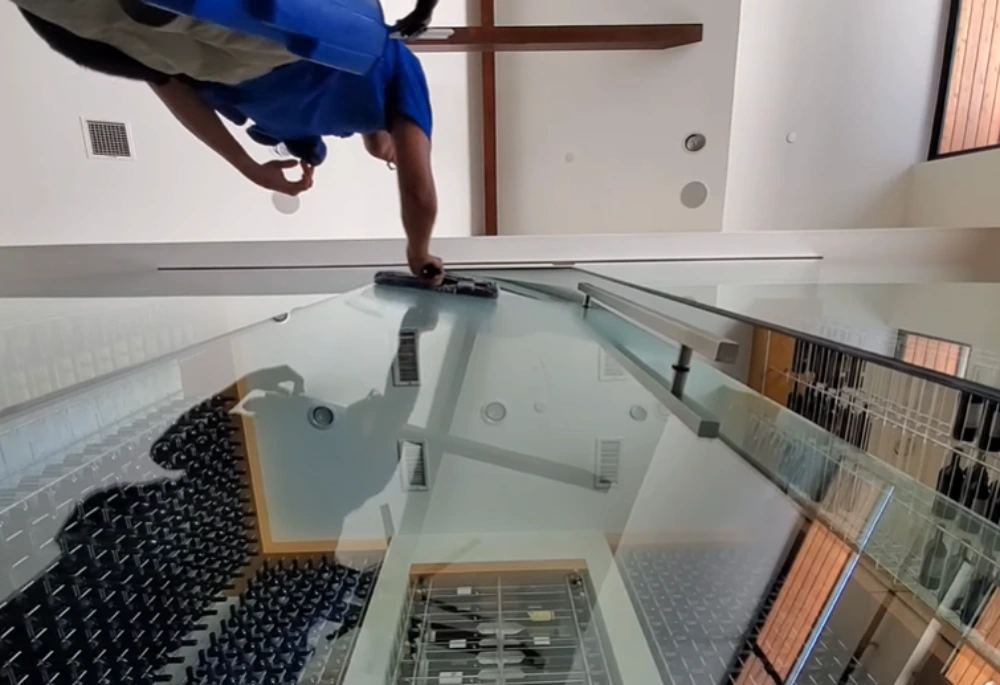 Glass railing panel after washing
| Patio surface | What we watch for | How we clean it |
|---|---|---|
| Interlocking pavers | Joint sand blown out by direct spray | Fan spray angled across the pavers; re-sand once dry |
| Flagstone | Soft or flaking stone and loose mortar | Pre-wet, low pressure tested on a hidden area |
| Concrete slab | Etching from a close wand | Surface cleaner for an even finish |
| Brick | Loose mortar joints | Low pressure, cleaner suited to masonry |
Unilock, a paver maker, advises against muriatic acid on pavers because it can etch them and change their color, and recommends testing any cleaner on a small area first. For more on concrete and paver stains, see our driveway and concrete cleaning page.
Sources: Unilock, Removing Stains From Pavers.
Glass Deck Railings Near the Coast
Glass railings keep the view open, but on coastal decks they collect salt spray and water spots quickly. Viewrail, a railing maker, recommends an ammonia-free glass cleaner, low pressure from a distance and no abrasive pads, harsh chemicals or metal scrapers, and says coastal glass needs wiping down more often.
For frameless panels, standoffs, top rails and balcony glass in more detail, see glass railing cleaning.
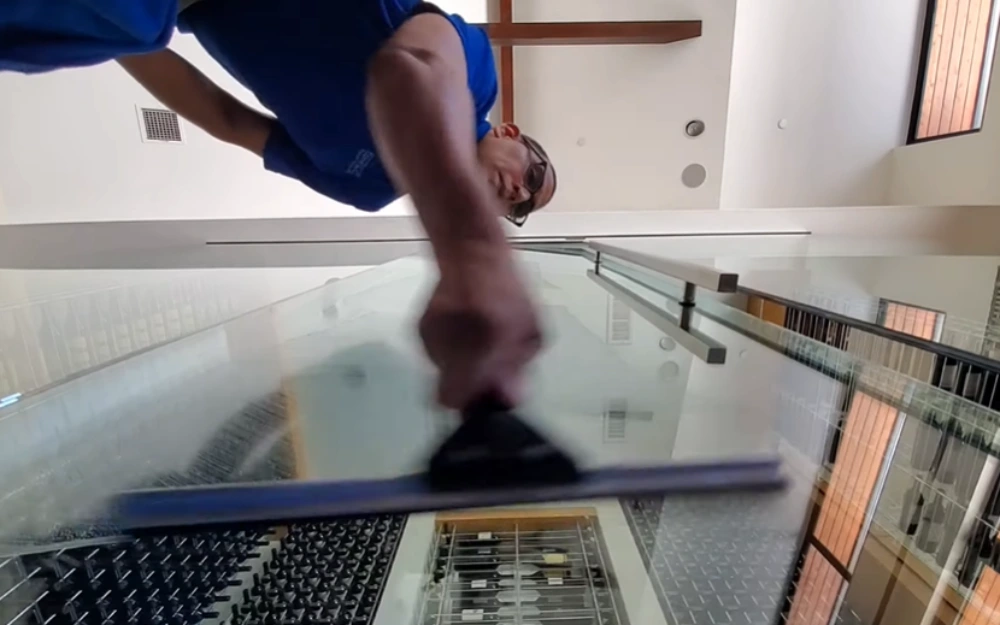 Squeegee work on balcony glass
- Rails are washed after the deck, so nothing drips back onto clean glass.
- Glass is cleaned with a strip washer and squeegee, then the edges and posts are detailed.
- Hard water spots from sprinklers are quoted separately, see hard water stain removal.
Sources: Viewrail, How to Maintain Glass Railing.
Protecting Plants and Keeping Wash Water Out of Drains
Santa Cruz County Public Works says storm drains flow directly to rivers, creeks and Monterey Bay without treatment. Decks often sit right above garden beds, so we plan for both.
- Plants under and around the deck are watered first and covered loosely, not sealed under plastic.
- We use only as much cleaner as the boards need and rinse plants thoroughly afterward.
- Drain inlets near the patio are blocked and wash water is kept on the property.
- No wash water is rinsed into the street or gutter.
Sources: Santa Cruz County Public Works, Residential Stormwater.
Deck and Patio Cleaning FAQ
What are the black stains on my deck and how do I get rid of them?
On redwood and cedar, black stains are often iron stains, where tannins in the wood react with metal from nails, fasteners or steel wool. They tend to look blue-black. An oxalic acid deck brightener neutralizes them, but they come back if the metal is still there. Dark spots shaped like fans or blotches are more often mildew, which needs a different cleaner.
Why does my redwood deck turn black after I power wash it?
Redwood is full of tannins that come to the surface when the wood is wet and react with iron in fasteners, tools or the water. Washing with chlorine bleach can also pull tannins up. Gentler cleaning, an oxalic acid brightener afterward and stainless or coated fasteners all help.
My cedar deck is fuzzy after pressure washing. What can I do?
The fuzz is wood fibers raised by too much pressure or too strong a cleaner. Let the deck dry completely, then lightly sand the raised fibers before staining, or the stain will soak in unevenly. Going forward, lower pressure or a hose and brush avoids it.
How long can I wait between washing a deck and staining it?
Stain once the wood is dry and passes the water test, which is often a day or two after washing. Waiting longer is fine as long as the deck stays clean. If pollen, leaves or dirt settle on it in the meantime, rinse it and let it dry again before staining.
Do I need to clean my deck before I stain it?
Yes. Stain does not bond well to dirt, mildew or a failing old finish. Cleaning, and brightening redwood or cedar, gives the new stain a clean surface to soak into. Stain makers commonly say most of the work in a good finish is in the prep.
How do I get rid of black mildew spots on a deck?
Mildew is a fungus, so it needs a cleaner that kills it, not just pressure. For wood, an oxygen bleach cleaner and a soft brush, followed by a gentle rinse, is the usual approach. Spots on a shaded deck come back unless it gets more sun and air or is cleaned regularly.
Will straight bleach clean a black deck?
It may lighten it, but chlorine bleach is not recommended on wood decks. It breaks down lignin, the natural glue that holds wood fibers together, which leaves a fuzzy, washed-out surface. It can also corrode fasteners and harm plants. Oxygen bleach is the gentler choice.
Do redwood decks need different prep than other decks?
Redwood and cedar both benefit from gentle cleaning and an oxalic acid brightener to deal with tannin and iron stains. The redwood and cedar associations and stain makers lean toward low pressure or a hose and brush rather than a pressure washer on these softwoods.
How do I get grill grease and sunscreen spots off a composite deck?
Clean them as soon as you can with warm soapy water and a soft brush, then rinse well so no film dries on the boards. Some makers list specific degreasers for their boards, so check your brand’s care guide before trying anything stronger.
Should flagstone be pre-soaked before washing, and what pressure is safe?
Wetting the stone first helps keep cleaners from soaking in too fast. Flagstone varies a lot in hardness, so start with low pressure on a hidden area and only go higher if the stone holds up. Soft or flaking stone should be cleaned by hand.
Get a Free Window Cleaning Quote in Santa Cruz County
Send your address and a few photos. You’ll hear back the same business day with a flat number.
(831) 203-3111- Same-day response, Monday through Saturday
- Flat quote, good for 30 days
- Add gutters, solar or skylights to the same visit
Serving Santa Cruz, Capitola, Aptos, Soquel, Live Oak, Scotts Valley, Felton, Ben Lomond, Bonny Doon, Watsonville and everywhere in between.